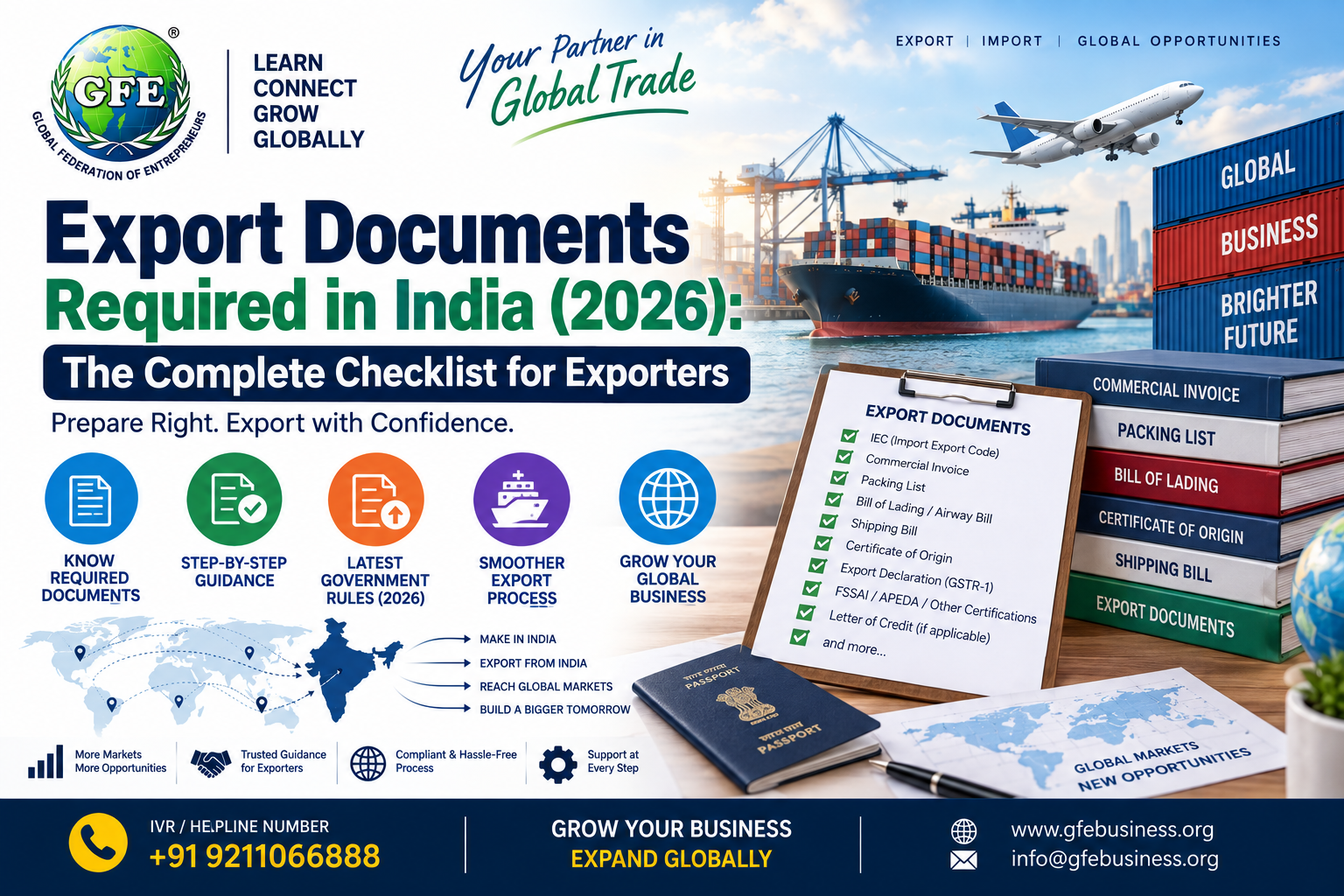
Export Documents Required in India (2026): The Complete Checklist for Exporters
One Missing Document Can Hold Your Container at Port for Days
We've seen this happen too many times in our 15+ years of training exporters: a shipment is packed, priced, and ready to sail — and then it sits at the port because one figure on the invoice doesn't match the packing list, or a certificate wasn't arranged in time.
Understanding the export documents required for your business isn't optional bureaucracy — it's what keeps your container moving, your payment arriving, and your GST refund from getting stuck. In India's 2026 digital customs environment, nearly every document is filed and cross-checked electronically, which means even small mismatches get flagged instantly instead of slipping through.
This guide breaks the checklist into two clear layers: documents you arrange once as a business, and documents you raise fresh for every shipment. We also cover the conditional certificates that only apply in specific cases, so you're not chasing paperwork you don't actually need.
One-Time vs Per-Shipment: The Distinction Most Guides Skip
Direct answer: Export documentation in India splits into one-time business registrations (obtained once and kept active) and per-shipment documents (raised fresh for every consignment) — most first-time exporters only need 4-6 core documents per actual shipment, not 10-12.
A common mistake we see in our training batches: new exporters assume every shipment needs a brand-new IEC, GST registration, or AD Code. In reality, these are set up once. Your export documentation checklist for each individual shipment is much shorter once your one-time registrations are in place.
One-Time Registrations You Need Before Your First Export
Direct answer: Before shipping anything internationally, an Indian exporter needs an IEC, GST registration, a Letter of Undertaking (LUT), and AD Code registration at the port they plan to ship from — with RCMC required only if claiming export incentives.
| Document | Issued By | Approx. Cost | Why It Matters |
|---|---|---|---|
| Import Export Code (IEC) | DGFT | ₹500 (one-time) | Mandatory 10-digit code; no export is legally possible without it |
| GST Registration (GSTIN) | GST Department | Free | Required for tax invoicing and refund claims |
| LUT (Letter of Undertaking) | GST Portal | Free | Lets you export without paying IGST upfront |
| AD Code Registration | Bank + Port Customs | Nominal bank charge | Without it, ICEGATE rejects your shipping bill at that port |
| RCMC (Registration Cum Membership Certificate) | Relevant Export Promotion Council | ₹2,000–₹10,000/year | Needed only if claiming RoDTEP, duty drawback, or scheme benefits |
One detail that trips up almost every first-timer: AD Code registration is port-specific. If you register your AD Code at the Mundra port and later ship from Nhava Sheva, you'll need to register it there too. Apply for IEC, GST, and AD Code in parallel rather than one after another — sequencing them one-by-one is the single biggest reason first shipments get delayed.
If you're still setting up your export business from scratch, our Exim Business Setup service handles these registrations for you so you're export-ready in days, not weeks.
Per-Shipment Export Documents: What You Need for Every Consignment
Direct answer: Every export shipment from India needs a Commercial Invoice, Packing List, Shipping Bill, and a Bill of Lading (sea) or Airway Bill (air) — these four apply regardless of product, buyer, or destination.
- Commercial Invoice: Your primary billing document. It doubles as the GST tax invoice, the basis for customs valuation, and the document your bank uses for FEMA compliance — so every number on it must match exactly across all other documents.
- Packing List: Details the exact contents, weight, and dimensions of each package. Customs and your freight forwarder both rely on this to verify what's inside without opening every box.
- Shipping Bill: The most important customs document for exports, filed electronically on ICEGATE. It's your legal proof of export and feeds directly into the Export Data Processing and Monitoring System (EDPMS) for payment tracking.
- Bill of Lading (sea freight) or Airway Bill (air freight): Issued by the shipping line or airline as proof the goods were shipped. A Bill of Lading can be negotiable, meaning it functions as a document of title — critical for letter-of-credit transactions. An Airway Bill is never negotiable.
In courier-based e-commerce exports, a CSB-V (Courier Shipping Bill) replaces the standard shipping bill for low-value, high-frequency shipments. As of early 2026, the government removed the earlier ₹10-lakh value cap on courier exports, opening this route up for more SMEs shipping directly to international buyers. If you're exporting through platforms like Amazon Global or Etsy, our E-commerce Export Support program walks you through CSB-V filing and marketplace-specific compliance.
Conditional Documents: Only Needed in Specific Cases
Direct answer: Certificate of Origin, Letter of Credit documentation, inspection certificates, and product-specific licenses are conditional export documents required only when the buyer, destination country, or product category demands them.
| Document | When It's Needed |
|---|---|
| Certificate of Origin | Buyer's country requires proof of Indian origin for customs duty or trade agreement benefits |
| Letter of Credit (LC) documentation | Payment is secured through a bank-issued LC rather than advance payment or open account terms |
| Inspection Certificate | Buyer or destination country mandates pre-shipment quality inspection (common for food, textiles, pharma) |
| Product-specific license/NOC | Restricted or regulated goods (chemicals, agricultural products, defence-adjacent items) |
| e-BRC (Electronic Bank Realisation Certificate) | Confirms foreign currency payment was received; needed to claim government export incentives |
A preferential Certificate of Origin — the kind that unlocks reduced import duty for your buyer under a trade agreement — needs extra documentation proving substantial transformation happened in India, not just a simple Chamber of Commerce stamp. Getting this wrong is a common reason exporters lose duty benefits they were otherwise entitled to.
Why Document Mismatches Are the #1 Cause of Delays and Refund Failures
Direct answer: A mismatch between your Shipping Bill and your GSTR-1 return — even a small difference in invoice number or value — will automatically block your GST refund until corrected, since the two systems are electronically matched.
The fix we recommend to every student in our training programs: prepare the Commercial Invoice first, then copy the exact same numbers, descriptions, and values onto every document that follows — packing list, shipping bill, GST invoice, all of it. Consistency across documents eliminates most mismatches before they ever happen.
India's Digital Customs Setup in 2026: What's Changed
Direct answer: Export documentation in India is now almost entirely digital — shipping bills, bills of entry, and e-BRCs are filed and reconciled electronically through ICEGATE, cutting manual paperwork but raising the cost of even small data mismatches.
Under what the industry is calling "Customs 2.0," your Airway Bill or Bill of Lading is electronically linked to your Shipping Bill for real-time tracking and faster clearance. This is good news for compliant exporters — clearance is faster — but it also means there's less room for the informal corrections that used to happen at the port counter. Getting your documents right the first time matters more now than it did five years ago.
For official updates on export procedures and policy, refer to the DGFT official portal, the Central Board of Indirect Taxes and Customs (CBIC), and FIEO for export promotion council guidance relevant to your product category.
Export Documentation Checklist: Quick Reference
Direct answer: Use this order — IEC, GST, LUT, and AD Code first as one-time setup; then Commercial Invoice, Packing List, Shipping Bill, and Bill of Lading/AWB for every shipment; add Certificate of Origin, e-BRC, or RCMC only if applicable.
- ☑ IEC registration (one-time)
- ☑ GST registration + LUT (one-time)
- ☑ AD Code registered at your shipping port (one-time, port-specific)
- ☑ RCMC (only if claiming export incentives)
- ☑ Commercial Invoice (every shipment)
- ☑ Packing List (every shipment)
- ☑ Shipping Bill / CSB-V for courier exports (every shipment)
- ☑ Bill of Lading or Airway Bill (every shipment)
- ☑ Certificate of Origin (if buyer/destination requires it)
- ☑ e-BRC (to claim incentives after payment realization)
FAQs on Export Documents Required in India
Getting Your Documentation Right the First Time
Export documentation looks intimidating on paper, but once you separate the one-time registrations from your per-shipment paperwork, it's a manageable, repeatable process — not a fresh mountain of forms every time you ship.
At GFE Business, our EXIM training programs cover this exact documentation flow alongside sourcing, logistics, and buyer outreach, so you're not learning it the hard way through a delayed shipment. If you want hands-on guidance through your first few exports, explore our Export Import Training program — it's built around the same real-world checklist covered here.