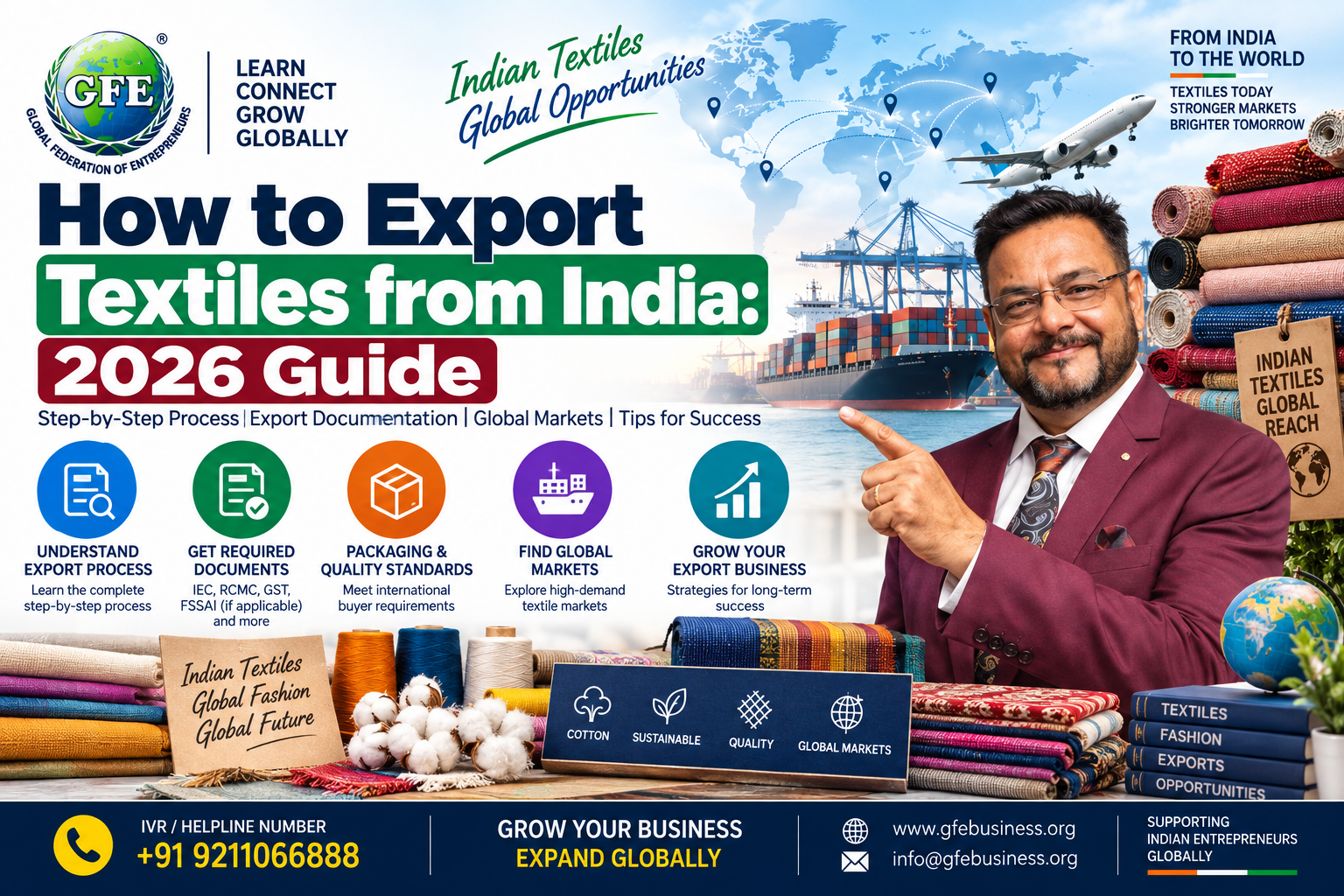
How to Export Textiles from India: 2026 Step-by-Step Business Guide
Export textiles from India, you need to select the right textile product and target market, establish your business, obtain an IEC from DGFT, identify reliable suppliers or manufacturing partners, understand the correct HS code and buyer requirements, prepare export documentation, and build a reliable international sales process. India already has a large textile-export ecosystem, with Gujarat, Tamil Nadu, Maharashtra and other states contributing significantly to global textile and apparel exports.
India has one of the world's most established textile and apparel manufacturing ecosystems, which makes textile exports an attractive business opportunity for manufacturers, traders, sourcing companies and new entrepreneurs.
If you want to export textiles from India, however, finding a product is only the beginning. You also need to understand product classification, HS codes, export documentation, quality requirements, pricing, logistics, payment terms and international buyer acquisition.
This textile export guide explains the process step by step, including the basic registrations, documents, product selection, pricing considerations and practical ways to find overseas buyers in 2026.
The key is not simply to ship fabric or garments overseas. A successful exporter builds a repeatable system covering product → supplier → buyer → compliance → documentation → logistics → payment.
Why Start a Textile Export Business from India in 2026?
India has a broad textile manufacturing base covering cotton, man-made fibres, yarn, fabrics, home textiles, garments, technical textiles and handicrafts.
According to the Ministry of Textiles, in FY 2024–25, the USA, UK and EU-27 together accounted for around 54.9% of India's textiles and apparel including handicrafts exports. The same ministry data shows that the top 10 exporting states accounted for approximately 90.7% of India's global textile and apparel including handicrafts exports. Gujarat alone accounted for about 15.7%.
This creates opportunities for exporters operating from traditional textile centres such as Gujarat, Maharashtra, Tamil Nadu, Haryana, Uttar Pradesh and Rajasthan.
For current trade data, India's official TradeStat system provides commodity-wise, country-wise and HS-code-level export data, with data available through 2026.
7 Steps to Export Textiles from India
The textile export process can be simplified into seven practical stages: choose the product, set up the business, obtain IEC, identify buyers, confirm specifications and pricing, prepare documentation, and complete shipment and payment.
Step 1: Choose the Right Textile Product
Your first decision should be what exactly you want to export.
Possible textile categories include:
- Cotton fabrics
- Polyester and synthetic fabrics
- Denim
- Home textiles
- Bed linen
- Towels
- Curtains
- Textile yarn
- Garments
- T-shirts
- Shirts
- Dresses
- Workwear
- Technical textiles
- Handloom products
- Made-ups
- Textile accessories
Do not choose a product only because it is popular in India.
Study:
- International demand
- Import volume of the target country
- Competition
- Buyer specifications
- Product quality requirements
- Shipping cost
- Minimum order quantity
- Expected gross margin
- Applicable duties and trade requirements
Use official trade databases to investigate the HS-code-level export market before committing significant working capital. India's TradeStat database allows exporters to examine commodity and country-wise trade information.
Step 2: Understand the HS Code Before You Quote a Buyer
The HS code is critical because your product's classification affects customs documentation, export policy, trade statistics and potentially applicable duties or schemes.
For example, textile products can fall under different chapters depending on whether you are exporting:
- Fibre
- Yarn
- Woven fabric
- Knitted fabric
- Garments
- Made-up textile articles
- Home-textile products
Never select an HS code simply because another exporter is using it.
Check the exact product description, material composition, construction and intended classification before preparing your commercial quotation.
Practical tip: Keep the product specification sheet ready with composition, GSM, width, weave/knit type, finish, size, colour and packing details. This makes HS-code and buyer discussions much easier.
Step 3: Set Up Your Export Business and Obtain IEC
An exporter normally needs an Importer Exporter Code (IEC) from DGFT to undertake export/import activities, subject to applicable exemptions. DGFT's current 2026 guidance continues to identify IEC as a core requirement for persons intending to import or export.
The basic setup generally involves:
- Business entity/proprietorship/partnership/company as applicable
- PAN
- Bank account
- GST registration where applicable
- IEC from DGFT
- Appropriate export banking arrangement
- Product-specific registrations or certifications where applicable
DGFT's IEC process is online, and the current DGFT IEC manual lists an IEC application fee of ₹500.
Basic IEC Process
- Register on the DGFT portal.
- Complete the exporter profile.
- Apply for IEC.
- Provide the required PAN, address, bank and identity details.
- Complete Aadhaar e-sign/DSC requirements as applicable.
- Pay the prescribed fee.
- Submit the application.
- Download/check the issued IEC.
DGFT's 2026 documentation states that the IEC application process is handled through the DGFT system.
Step 4: Find Reliable Textile Suppliers or Manufacturing Partners
You don't necessarily need your own textile factory to start exporting.
There are several business models:
| Model | How It Works | Suitable For |
|---|---|---|
| Manufacturer-exporter | You manufacture and export directly | Textile manufacturers |
| Merchant exporter | You source from manufacturers and export | New exporters/traders |
| Sourcing company | You connect buyers with Indian suppliers | Buyer-focused businesses |
| Private label | Manufacturer produces under your buyer's brand | Fashion/e-commerce exporters |
| Contract manufacturing | Production is made according to agreed specifications | Established buyers |
For beginners, a merchant-exporter or sourcing model can reduce the need for heavy manufacturing investment.
However, supplier selection is critical. Check:
- Production capacity
- Product quality
- Sample quality
- MOQ
- Lead time
- Certifications
- Packaging capability
- Export experience
- Payment terms
- Quality-control process
Never promise a buyer a quantity or delivery date before confirming production capacity with your supplier.
Step 5: Select the Right International Market
The best market depends on your textile category, pricing and buyer requirements.
Potential markets may include:
- USA
- UK
- UAE
- Saudi Arabia
- Germany
- France
- Netherlands
- Spain
- Australia
- Canada
- Japan
- Other Middle Eastern and European markets
The Ministry of Textiles' FY 2024–25 data identifies the USA, UK and EU-27 as major destinations for India's textiles and apparel including handicrafts.
Instead of targeting every country, start with one product + one market + one buyer segment.
For example:
Indian cotton home textiles → UAE → hotel and hospitality suppliers
This is much easier to execute than trying to sell every textile product to every country.
Step 6: Find International Textile Buyers
Finding buyers is one of the most important parts of the export business.
Potential buyer types include:
- Importers
- Wholesalers
- Distributors
- Retail chains
- Garment manufacturers
- Fashion brands
- Hotel suppliers
- Home furnishing companies
- Private-label brands
- E-commerce sellers
Your buyer-acquisition strategy can include:
- B2B marketplaces
- Direct email outreach
- LinkedIn prospecting
- Trade fairs
- Buyer-seller meets
- Export promotion events
- Distributor outreach
- Country-specific business directories
- Existing importer databases
- Referrals
A buyer should receive more than a generic message saying, "We are textile exporters from India."
Your first communication should clearly explain:
- Product
- Material
- Specifications
- MOQ
- Available certifications
- Production capacity
- Target market experience
- Sample availability
- Incoterm
- Approximate price range
You can also study our guide on how beginners can find international buyers and apply the same buyer-research principles to textile products.
Step 7: Prepare Export Documents and Ship the Order
Once a buyer confirms the order, documentation and logistics become critical.
Common export documents can include: How Beginners Can Find International Buyers
- Commercial Invoice
- Packing List
- Shipping Bill
- Bill of Lading or Airway Bill
- Certificate of Origin, where required
- Purchase Order/Export Contract
- Insurance document, where applicable
- Inspection/quality certificate, where required
- Product-specific certificates
- Other customs or destination-country documents
The exact documentation depends on the product, destination, buyer requirements, payment terms and applicable regulations.
Government export guidance also identifies commercial invoices, bills of lading, certificates of origin, inspection certificates, insurance certificates and export packing lists among commonly used export documents, while noting that requirements vary by transaction.
For a new exporter, working with an experienced freight forwarder or CHA can help reduce documentation and customs errors.
How Much Does It Cost to Start a Textile Export Business?
There is no single fixed investment because the cost depends heavily on whether you manufacture, trade or source products.
| Expense | Typical Planning Consideration |
|---|---|
| Business setup | Depends on entity and professional requirements |
| IEC application | ₹500 government application fee |
| Product samples | Depends on textile and supplier |
| Packaging | Depends on product and destination |
| Website/catalogue | Depends on quality and scope |
| Buyer acquisition | Depends on marketing method |
| Freight | Depends on shipment volume, destination and mode |
| CHA/freight-forwarding | Depends on shipment and service |
| Working capital | Depends mainly on order size and supplier terms |
The important point is that starting an export business does not necessarily mean purchasing a factory or maintaining large inventory.
A merchant exporter can start by sourcing products against confirmed buyer requirements, provided supplier capacity, quality and payment terms are properly managed.
How Should You Price Textile Products for Export?
Export pricing should include more than your factory purchase price.
A practical calculation can include:
Product Cost + Packaging + Inland Transportation + Documentation/Handling + CHA/Forwarding Charges + Freight/Insurance Where Applicable + Bank/Transaction Costs + Margin = Export Price
You also need to decide which Incoterm you are quoting, such as:
- EXW
- FOB
- CFR
- CIF
- Other agreed Incoterms
Do not compare an FOB quotation directly with a CIF quotation. The cost responsibilities are different.
For a beginner, clearly stating the Incoterm, currency, MOQ, validity period and payment terms on every quotation can prevent costly misunderstandings.
What Certifications Do Textile Exporters Need?
Certification requirements vary according to the product, destination and buyer.
A buyer may request documentation related to:
- Fibre composition
- Product safety
- Chemical compliance
- Social compliance
- Factory audits
- Quality inspection
- Sustainability
- Organic claims
- Destination-country regulations
There is no universal certification that every textile exporter must obtain.
For example, an organic-textile transaction can involve additional requirements, while a standard commercial textile order may have different buyer specifications. DGFT-related notices have also addressed organic textiles, demonstrating why exporters should verify current product-specific rules before shipment.
Always confirm the buyer's requirements before production, not after the goods are ready.
Textile Export Business: Manufacturer vs Merchant Exporter
Both models can work, but their operational requirements are different.
| Factor | Manufacturer Exporter | Merchant Exporter |
|---|---|---|
| Factory | Required | Not necessarily |
| Investment | Generally higher | Can be lower |
| Product control | Higher | Depends on supplier |
| Supplier dependency | Lower | Higher |
| Scalability | Manufacturing capacity dependent | Supplier network dependent |
| Suitable for | Manufacturers | Traders and new exporters |
A merchant exporter can focus on finding buyers, developing suppliers and managing international transactions instead of investing immediately in manufacturing infrastructure.
If you need structured guidance on setting up an export business, explore GFE Business's Export Import Training and business-support services.
Common Mistakes New Textile Exporters Should Avoid
The most common mistakes are usually operational rather than technical.
1. Choosing a product without checking demand
A product can sell well domestically but have weak demand in a particular export market.
2. Quoting without understanding Incoterms
A low-looking price can become unprofitable if freight and other responsibilities have not been calculated.
3. Ignoring product specifications
International buyers may have strict requirements for composition, GSM, colour, dimensions, shrinkage, stitching, packaging and labelling.
4. Depending on one supplier
Always have backup suppliers for important products.
5. Accepting an unfamiliar payment structure without risk assessment
Payment terms should be evaluated according to buyer credibility, order size and transaction risk.
6. Treating documentation as an afterthought
Incorrect documents can delay customs clearance and create additional costs.
7. Chasing too many markets at once
Start with a focused product-market strategy and expand after you understand the process.
2026 Textile Export Strategy: A Practical Beginner Roadmap
If I were helping a new exporter structure the first 90 days, I would focus on execution rather than trying to build everything at once.
Days 1–15: Product Research
- Select 1–3 textile products.
- Research HS codes.
- Identify 2–3 target countries.
- Study competitors.
- Check buyer specifications.
- Prepare product samples.
Days 16–30: Business Setup
- Complete business registrations.
- Apply for IEC.
- Set up banking.
- Prepare catalogue and website.
- Finalise supplier relationships.
- Create export quotation templates.
Days 31–60: Buyer Acquisition
- Build a list of qualified buyers.
- Start personalised outreach.
- Contact distributors and importers.
- Attend relevant trade events.
- Send samples to serious prospects.
- Track every enquiry in a CRM or spreadsheet.
Days 61–90: First Order Execution
- Negotiate commercial terms.
- Confirm purchase order.
- Finalise specifications.
- Arrange production.
- Conduct quality checks.
- Prepare documentation.
- Coordinate CHA/freight forwarder.
- Complete shipment and payment process.
This approach gives you a measurable system instead of simply "trying export."
Where Does India Export Textiles From?
Textile exports originate from many parts of India.
The Ministry of Textiles reported that textile and apparel products including handicrafts were exported from 527 districts across 28 states and 8 Union Territories during FY 2024–25. Tamil Nadu, Gujarat, Haryana and Maharashtra were among the major exporting states.
For businesses in Gujarat, this is particularly relevant because Gujarat accounted for around 15.7% of India's global textiles and apparel including handicrafts exports in FY 2024–25 according to the ministry's data.
This makes cities such as Ahmedabad and Surat relevant locations for sourcing, manufacturing, trading and export-related services.
Related Reads
- How Beginners Can Find International Buyers
- Import Export Business Plan in India
- B2B Export Business Strategy in India
- Start Import Export Without Experience in India
You can also explore GFE Business's broader Import Export Business category for additional guides on export documentation, buyers, business setup and international trade.
Frequently Asked Questions
Q: How do I export textiles from India?
A: Start by selecting a textile product and target market, establish your business, obtain an IEC from DGFT, identify suppliers, confirm HS classification and buyer requirements, prepare export documentation, arrange logistics and complete the shipment/payment process.
Q: Is IEC mandatory for textile exports?
A: IEC is generally required for undertaking export/import activities, subject to applicable exemptions. DGFT's 2026 IEC guidance specifically states that persons intending to import/export are required to have an IEC unless exempted under the applicable provisions.
Q: Can I start a textile export business without owning a factory?
A: Yes. A merchant-exporter model allows you to source products from manufacturers and focus on buyer acquisition, product selection, quality control, documentation and international sales.
Q: How much money is required to start a textile export business?
A: There is no universal investment amount. A sourcing or merchant-export model can require significantly less capital than establishing a manufacturing unit. Your major working-capital requirement will depend on product MOQ, supplier payment terms, buyer payment terms, freight and order size.
Q: Which textile products can I export from India?
A: Common categories include cotton fabrics, synthetic fabrics, yarn, garments, home textiles, towels, bed linen, denim, made-ups and technical textiles. The correct export classification depends on the exact product.
Q: Which countries buy textiles from India?
A: Major markets include the USA, UK and countries in the EU, while Indian textile exporters also serve markets in the Middle East, Asia, Africa and other regions. Market suitability depends on product type, specifications, price and regulatory requirements.
Q: Do I need a textile-specific certification to export?
A: Not necessarily. Certification and compliance requirements vary according to the product, buyer and destination market. Confirm the exact requirements before production and shipment.
Q: Can I learn the textile export process through an import-export course?
A: Yes. A structured EXIM course can help beginners understand IEC, documentation, international buyers, pricing, logistics, payment terms and export procedures before handling their first shipment.
Conclusion: Build a Textile Export Business Step by Step
Learning how to export textiles from India is less about simply finding a foreign buyer and more about building a reliable export process.
Start with one product, understand its HS classification, select a focused market, build reliable supplier relationships, obtain the necessary registrations, learn export documentation and develop a repeatable buyer-acquisition system.
India's large textile ecosystem provides opportunities for manufacturers, traders and merchant exporters, but success depends on product quality, pricing, compliance, buyer trust and consistent execution.
If you are new to international trade and want structured guidance on product selection, IEC, documentation, buyer finding, logistics and export business setup, explore GFE Business Export Import Training and related EXIM support services.
About GFE Business / Reviewed by Trade Experts
This article is prepared for educational purposes by GFE Business's trade-training and export-business team. GFE Business provides guidance across import-export training, EXIM business setup, documentation, buyer development, logistics coordination and international trade support.
Regulations, product requirements, customs procedures and destination-country rules can change. Always verify the latest applicable requirements with the relevant government authority before executing an export transaction.
export textiles from India, textile export guide, textile export business India, how to export textiles from India, textile exporters in India, textile export business plan, textile export business for beginners, textile export process India, textile export documents, textile HS code, textile buyers from India, textile suppliers India, export garments from India, cotton fabric export from India, home textile export India, textile export business cost, textile export business 2026, textile exporters Ahmedabad, textile exporters Surat, textile export training India