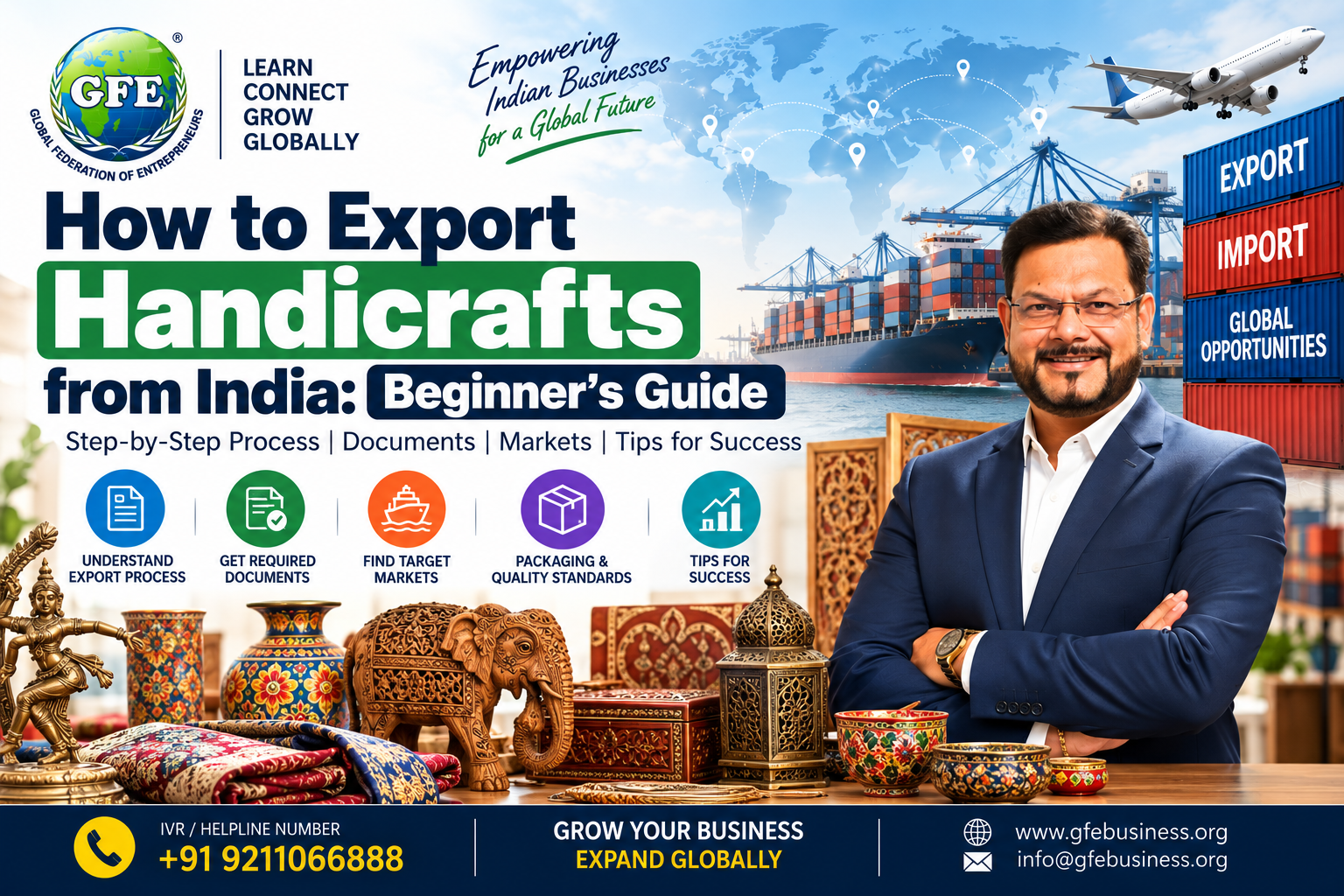
India is known for its diverse handicrafts, traditional craftsmanship and handmade products. From wooden handicrafts and metalware to textiles, home decor, jewellery, carpets and eco-friendly products, Indian handicrafts have opportunities in international markets.
If you are a beginner and want to learn how to export handicrafts from India, you need to understand more than just finding an overseas buyer. You also need to prepare your business, understand export documentation, identify the right products and markets, calculate costs and arrange shipping correctly.
This beginner's guide explains the major steps involved in starting a handicraft export business from India.
New to exporting from India? Read our Import Export Business Guide first.
Why Export Handicrafts from India?
Indian handicrafts are valued for their traditional designs, craftsmanship, regional identity and variety of materials. Depending on the product and target market, exporters can explore opportunities with importers, wholesalers, retailers, distributors, interior businesses, hospitality companies and online sellers.
Popular handicraft categories include:
- Wooden handicrafts
- Metal handicrafts
- Handmade home decor
- Indian textiles
- Carpets and rugs
- Cane and bamboo products
- Jute and natural fibre products
- Handmade paper products
- Decorative products
- Handmade jewellery and accessories
- Gifts and lifestyle products
- Festive and seasonal decorations
EPCH, the Export Promotion Council for Handicrafts, provides exporter guidance and resources covering handicraft exports, compliance, packaging, customs, trade policy and other areas relevant to exporters. :chatgpt-content-reference{index="0"}
How to Export Handicrafts from India: Step-by-Step
The basic process can be divided into the following steps:
- Select the handicraft products you want to export.
- Choose your target international market.
- Set up your export business.
- Obtain the required IEC.
- Understand product-specific requirements.
- Consider relevant handicraft export registration and industry support.
- Find genuine international buyers.
- Prepare product samples and quotations.
- Negotiate payment and delivery terms.
- Prepare export documentation.
- Arrange packaging and logistics.
- Complete customs and shipment procedures.
- Follow up with the buyer and build repeat business.
Step 1: Choose Handicraft Products for Export
Your first decision should be what type of handicraft products you want to export.
Do not select products only because they are popular in India. International demand, product regulations, shipping cost, breakage risk, packaging requirements, competition and buyer preferences should also be considered.
For example, lightweight products may be easier to ship internationally than large or fragile products. Similarly, products made from wood, natural fibres or other regulated materials may require additional compliance depending on the destination market.
Before selecting a product, research:
- International demand
- Competition
- Product specifications
- HS classification
- Target buyer segment
- Shipping cost
- Packaging requirements
- Destination-country regulations
- Expected profit margin
Step 2: Select Your Target Export Market
After selecting your products, decide where you want to sell them.
Potential markets can include countries in the Middle East, Europe, North America, Asia-Pacific and other regions. However, the best market depends on your product category rather than simply the size of a country's economy.
For each target market, research:
- Existing demand
- Local competitors
- Import requirements
- Product standards
- Packaging and labelling rules
- Import duties and taxes
- Buyer preferences
- Shipping routes
- Payment practices
Step 3: Set Up Your Export Business
You need a suitable business structure and the relevant registrations before starting commercial exports.
Depending on your business structure, this can involve registrations and documentation related to your business entity, PAN, GST and banking arrangements.
It is important to check the current requirements applicable to your business and product category before starting exports.
Step 4: Obtain an Importer Exporter Code (IEC)
The Importer Exporter Code (IEC) is a key requirement for businesses undertaking import or export activities, subject to applicable exemptions.
DGFT provides the IEC application facility through its online platform. The current DGFT guidance states that persons intending to import or export generally need an IEC unless they fall under an applicable exemption. :chatgpt-content-reference{index="1"}
Before applying, make sure your business, PAN, address, bank and other required details are correctly prepared.
Visit the official DGFT website
Step 5: Understand EPCH Registration for Handicraft Exporters
The Export Promotion Council for Handicrafts (EPCH) is the sector-specific organisation that promotes and supports handicraft exports from India.
EPCH states that membership is available to businesses engaged in handicraft exports, and exporters can register as merchant exporters, manufacturer exporters or merchant-cum-manufacturer exporters according to the applicable documentation. :chatgpt-content-reference{index="2"}
EPCH also states that an IEC is required for its membership/registration process. :chatgpt-content-reference{index="3"}
However, EPCH's FAQ notes that registration with the Council is not itself mandatory for exporting handicrafts, although registration can provide access to Council services and assistance available to exporters. :chatgpt-content-reference{index="4"}
Therefore, beginners should check their exact product, export activity and current policy requirements before deciding which registrations are applicable.
Step 6: Find International Buyers for Indian Handicrafts
Finding genuine buyers is one of the most important parts of an export business.
Potential buyers can include:
- Importers
- Wholesalers
- Distributors
- Retailers
- Interior design companies
- Home decor businesses
- Gift companies
- Hospitality businesses
- E-commerce sellers
- Private-label businesses
You can use several channels to find buyers, including B2B platforms, trade fairs, export directories, industry associations, business networking, direct outreach and international exhibitions.
Do not send the same generic message to every buyer. Your outreach should include relevant product information, images, specifications, MOQ, pricing basis and your ability to supply consistently.
How to Find Genuine Handicraft Buyers
Before accepting an overseas order, conduct reasonable buyer due diligence.
Check:
- Company website
- Business registration details where available
- Company address
- Business email
- Import history where legally and commercially available
- Buyer references where appropriate
- Requested payment terms
- Shipping and destination details
EPCH itself has published guidance warning exporters about fraudulent overseas buyers and recommends background checks, credential verification and secure payment practices. :chatgpt-content-reference{index="5"}
Step 7: Prepare Your Handicraft Product Catalogue
A professional product catalogue can make buyer communication easier.
For each product, consider including:
- Product name
- Product photographs
- Product code
- Dimensions
- Material
- Weight
- Available colours or designs
- MOQ
- Packaging details
- Price or quotation basis
- Production lead time
- Available certifications, if applicable
High-quality photographs are particularly important for handicrafts because buyers need to understand the finish, design, texture and overall appearance of the product.
Step 8: Calculate Your Export Price
Do not calculate your export price only from your manufacturing or purchase cost.
Your quotation may need to consider:
- Product cost
- Labour and finishing
- Packaging
- Quality inspection
- Local transportation
- Documentation
- Freight
- Insurance, where applicable
- Banking and payment-related charges
- Applicable taxes, duties or other charges
- Profit margin
Your final quotation should also clearly state the applicable Incoterm and what is included or excluded from the quoted price.
Step 9: Negotiate With the Overseas Buyer
Price is only one part of an export negotiation.
Discuss the following before confirming an order:
- Product specifications
- Quantity
- MOQ
- Price
- Payment terms
- Production timeline
- Packaging
- Shipping terms
- Inspection requirements
- Required documents
- Delivery destination
For customised handicrafts, make sure the final design, dimensions, materials, colours and packaging requirements are confirmed in writing.
Step 10: Prepare Handicraft Export Documents
Export documentation can vary depending on the product, destination, shipment method, buyer requirements and applicable regulations.
Common export documents can include:
- Commercial invoice
- Packing list
- Shipping bill
- Transport document such as Bill of Lading or Air Waybill
- Certificate of Origin, where required
- Product-specific certificates or documents, where applicable
- Insurance documents, where applicable
CBIC identifies the shipping bill, commercial invoice and packing list among documents relevant to exports. Exporters must also comply with restrictions or prohibitions applicable to their goods. :chatgpt-content-reference{index="6"}
For a Certificate of Origin, exporters can use the DGFT Common Digital Platform where applicable. :chatgpt-content-reference{index="7"}
Step 11: Packaging for International Handicraft Shipments
Handicraft products can be fragile, decorative or sensitive to moisture and handling. Export packaging should therefore be designed according to the product and shipping method.
Consider:
- Product protection
- Moisture protection
- Shock protection
- Inner packaging
- Outer cartons
- Labelling
- Carton dimensions
- Weight limitations
- Container utilisation
For fragile products, test packaging before shipping a commercial order.
Step 12: Arrange Shipping and Customs Clearance
Once the order is ready, arrange transportation according to the agreed delivery terms.
Depending on shipment size, urgency and destination, exporters may consider air freight, sea freight, courier or other suitable logistics solutions.
For exports by vessel or aircraft, Indian customs law provides for the electronic presentation of a shipping bill through the customs automated system, subject to applicable procedures. :chatgpt-content-reference{index="8"}
For commercial shipments, many new exporters work with a customs broker, freight forwarder or logistics provider to coordinate documentation and shipment procedures.
Step 13: Receive Payment Safely
Payment terms should be agreed before production or shipment.
Depending on the buyer relationship and transaction structure, exporters may use payment methods and terms such as advance payment, documentary collections, letters of credit or other agreed arrangements.
For new buyers, do not accept unusual payment instructions without proper verification. Confirm the buyer's banking details and transaction terms carefully.
Popular Indian Handicraft Products for Export
Indian exporters can explore several handicraft categories depending on international demand and their production capabilities.
| Category | Examples |
|---|---|
| Wooden Handicrafts | Decorative pieces, boxes, furniture and carved products |
| Metal Handicrafts | Decorative items, lamps, sculptures and utensils |
| Textile Handicrafts | Handmade fabrics, embroidered products and decorative textiles |
| Natural Fibre Products | Cane, bamboo, jute and other natural fibre products |
| Home Decor | Wall decor, decorative accessories and lifestyle products |
| Gifts | Corporate gifts, festive products and handmade gift items |
How Much Does It Cost to Start a Handicraft Export Business?
There is no single fixed investment required to start exporting handicrafts from India.
Your initial cost can depend on:
- Business setup
- Product sourcing or manufacturing
- Samples
- Packaging
- Product photography
- Website or catalogue
- Buyer acquisition
- Trade fairs
- Freight
- Documentation
- Working capital
A small exporter can start by testing international demand with samples and smaller orders before scaling the business.
How GFE Business Can Help New Exporters
Starting an export business involves product selection, market research, buyer identification, documentation, pricing and logistics decisions.
GFE Business provides import-export training and business support for entrepreneurs who want to understand international trade and develop their export business.
Explore GFE Business Import Export Training and Business Support
Before starting a commercial shipment, exporters should independently confirm the current requirements applicable to their specific product and destination country.
Common Mistakes Beginners Should Avoid
- Choosing a product without checking international demand
- Not researching the destination market
- Quoting prices without calculating complete export costs
- Ignoring packaging requirements
- Accepting an overseas buyer without basic due diligence
- Not checking product-specific regulations
- Using incorrect HS classification
- Not confirming payment terms
- Failing to document product specifications
- Underestimating working capital requirements
Frequently Asked Questions About Handicraft Export from India
How can I start exporting handicrafts from India?
Start by selecting a product, researching international demand, setting up your export business, obtaining the required registrations such as IEC, finding buyers and preparing the documentation and logistics required for your shipments.
Is IEC required to export handicrafts from India?
Businesses intending to export generally need an Importer Exporter Code, subject to applicable exemptions. Check the latest DGFT requirements for your specific situation. :chatgpt-content-reference{index="9"}
Is EPCH registration mandatory for handicraft exporters?
EPCH's FAQ states that registration with the Council is not mandatory for exporting handicrafts, although membership and registration can provide access to Council services and assistance available to exporters. :chatgpt-content-reference{index="10"}
What handicraft products can I export from India?
Examples include wooden products, metalware, textiles, carpets, rugs, cane and bamboo products, jute products, home decor, handmade gifts and other suitable handicraft products.
How do I find international buyers for handicrafts?
You can find potential buyers through B2B marketplaces, trade fairs, export directories, industry networks, direct outreach and other business development channels.
What documents are required to export handicrafts?
Common documents can include a commercial invoice, packing list, shipping bill and transport document. Additional certificates or documents may be required depending on the product, destination and buyer requirements. :chatgpt-content-reference{index="11"}
Can I export handicrafts without manufacturing them myself?
Yes. An exporter can operate as a merchant exporter by sourcing products from manufacturers or suppliers and exporting them, subject to applicable requirements.
Which countries buy Indian handicrafts?
Indian handicrafts are sold in international markets across multiple regions. The right destination depends on the specific product, buyer segment, competition, regulations and shipping economics.
How can I calculate the price of handicrafts for export?
Consider product cost, packaging, local transportation, documentation, freight, applicable charges and your desired margin. Also clearly define the applicable delivery term in the quotation.
Final Checklist for New Handicraft Exporters
- Choose your handicraft product.
- Research international demand.
- Select your target market.
- Set up your export business.
- Obtain IEC and other applicable registrations.
- Research product-specific compliance.
- Create a professional product catalogue.
- Find and verify potential buyers.
- Prepare samples and quotations.
- Agree on payment and delivery terms.
- Prepare export documentation.
- Arrange suitable packaging.
- Coordinate customs and logistics.
- Track the shipment and follow up with the buyer.
Conclusion
Exporting handicrafts from India can be a practical opportunity for manufacturers, artisans, traders and entrepreneurs who are prepared to understand international buyer requirements and manage the export process properly.
The key is to start with the right product and market, build a reliable buyer pipeline, calculate your costs accurately, follow applicable regulations and maintain proper documentation throughout the transaction.
If you are new to international trade, structured import-export training can help you understand the export process before you start approaching overseas buyers.
Learn More About GFE Business Import Export Training
Important: Export rules, documentation and destination-country requirements can change. Always verify the latest requirements with the relevant government authorities, customs authorities and applicable export promotion council before completing a commercial shipment.