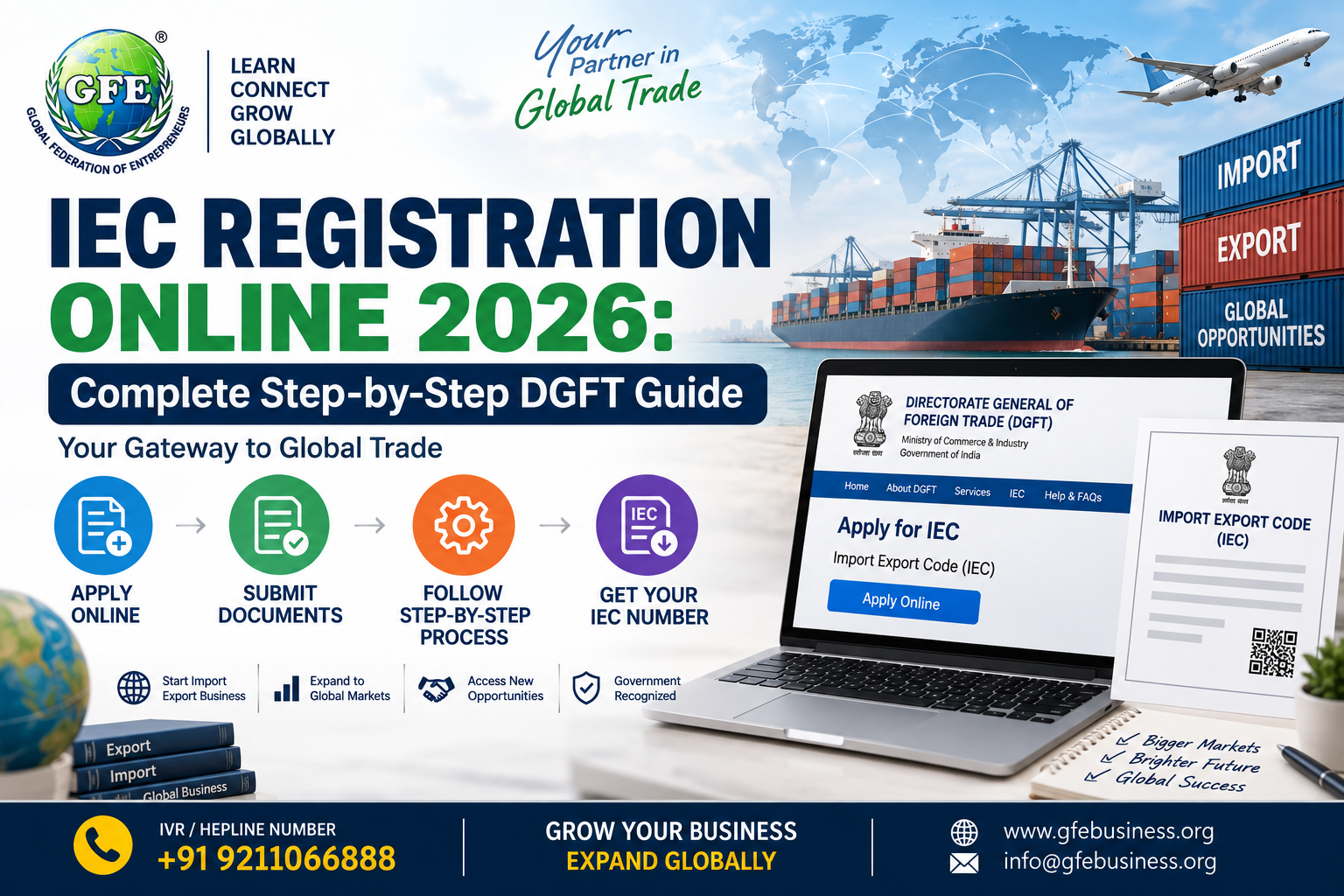
IEC Registration Online 2026: Complete Step-by-Step DGFT Guide
You Can't Legally Export a Single Shipment Without This Code
Here's a scene we've watched play out more times than we can count in 15+ years of training exporters: a first-time entrepreneur books a container, finalizes a buyer overseas, and then discovers at the port that customs won't clear the shipment without an Importer Exporter Code.
The IEC (Import Exporter Code) is a 10-digit number issued by the Directorate General of Foreign Trade (DGFT) under the Ministry of Commerce and Industry. Since it's now aligned with your PAN, the government treats it as your business's international trade identity — no IEC, no legal import or export activity, no customs clearance, no way to receive certain foreign remittances.
This guide walks you through the exact IEC registration online process for 2026: documents, fees, timelines, common mistakes, and what happens after you get your certificate. We train exporters at GFE Business, part of GFE Group, and this is the same sequence we walk our students through before they place their first international order.
What Is an IEC Code and Who Actually Needs One?
An IEC code is a mandatory 10-digit business identification number for anyone importing goods into India or exporting goods and services out of India, except a short exemption list defined by the Foreign Trade Policy.
The IEC (Import Exporter Code) is issued once per PAN — a proprietorship, partnership, LLP, private limited company, or even an individual can hold one, but only one IEC per legal entity.
You need an IEC if you:
- Plan to import raw materials, machinery, or finished goods for your business
- Want to export products or services and claim benefits under the Foreign Trade Policy
- Are setting up an e-commerce export business (Amazon Global, Etsy, Shopify cross-border)
- Need to receive large foreign remittances that banks flag for verification
- Want to register on ICEGATE for customs filing
Who's exempt? Government departments, certain notified charitable institutions, and individuals importing/exporting for personal use (non-commercial) generally don't need one. Pure service exporters who don't claim any FTP incentive can also operate without it in many cases, though most banks still ask for it once remittance volumes grow.
If you're exploring whether import-export is the right business model for you at all, our complete import export business guide is a good starting point before you get into registrations.
IEC Registration Online: Documents You Need Before You Start
Direct answer: You need PAN, address proof, a cancelled cheque or bank certificate, and a digital signature or Aadhaar-based e-sign to complete IEC registration online — no physical paperwork is required.
| Document | Format Accepted | Notes |
|---|---|---|
| PAN card (business/individual) | PDF/JPEG | Mandatory; IEC number = PAN in most cases |
| Address proof (electricity bill, rent agreement, sale deed) | PDF/JPEG | Must match business address on record |
| Cancelled cheque or bank certificate | PDF/JPEG | Current bank account in business name |
| Digital Signature Certificate (DSC) or Aadhaar e-sign | Class 3 DSC or OTP | Used for final submission |
| Photograph of applicant/authorised signatory | JPEG | Recent passport-size |
| Certificate of Incorporation / Partnership Deed (if applicable) | For companies, LLPs, partnerships |
Keep file sizes under the portal's upload limit (usually 5MB per document) to avoid upload errors — one of the most common reasons applications get stuck at the submission stage.
Step-by-Step DGFT IEC Registration Process (2026)
Direct answer: IEC registration online is completed in eight steps on the DGFT portal: register, fill Form ANF-2A, upload documents, pay ₹500, e-sign, submit, and download your certificate after DGFT verification.
- Register on the DGFT portal. Visit dgft.gov.in and create a login using your PAN and a valid mobile number/email. If you already have credentials, log in directly.
- Open Form ANF-2A. Navigate to Services → IEC Profile Management → Apply for IEC.
- Enter business and applicant details. Entity type, PAN, registered address, and details of the authorised signatory.
- Add bank account details. Account number, IFSC, and branch — this account is linked for any future refunds or remittance verification.
- Upload the required documents. PAN, address proof, bank proof, and photograph, in the specified format.
- Pay the government fee. The IEC application fee is a flat ₹500, paid via the Bharatkosh payment gateway using net banking, UPI, or a credit/debit card. Save the receipt — you'll need it for any future correspondence.
- E-sign and submit. Authenticate using DSC or Aadhaar OTP, then review every field carefully before final submission — post-submission corrections require a separate amendment (₹200 fee).
- Receive and download your e-IEC. Once DGFT verifies your application, the certificate is generated automatically and available for download from your dashboard — typically within 1 to 3 working days.
If any of this feels like one more thing on an already long checklist while you're setting up your first export order, our Exim Business Setup service handles the documentation and filing end-to-end so you can focus on sourcing and buyers.
IEC Registration Fees: What You Actually Pay in 2026
Direct answer: The official DGFT government fee for IEC registration is ₹500, one-time and non-refundable; going through a consultant typically pushes the total to ₹1,500–₹5,000 depending on the service scope.
| Component | Cost (Approx.) | When It Applies |
|---|---|---|
| DGFT government fee | ₹500 | Every fresh application (mandatory) |
| IEC amendment fee | ₹200 | Only if you need to correct submitted details |
| Digital Signature Certificate (DSC) | ₹1,500–₹2,500 | If you don't use Aadhaar e-sign |
| Consultant/professional fee | ₹1,000–₹3,000 | Optional, for assisted filing |
| Annual IEC confirmation | Free | Mandatory April–June every year |
Filing it yourself with Aadhaar e-sign is the cheapest route at ₹500 flat. The extra cost only shows up if you skip the DSC/e-sign step or bring in a consultant for convenience.
Timeline: How Long Does IEC Registration Actually Take?
Direct answer: Most IEC applications are processed within 1 to 3 working days once documents are correctly uploaded and the fee is paid; delays almost always come from mismatched address proof or incomplete bank details.
In our own training batches, students who prepare documents in advance matching name spellings across PAN, bank proof, and address proof exactly — get their e-IEC in 24-48 hours. The ones who rush usually get sent back for resubmission, which resets the clock.
What Happens After You Get Your IEC?
Getting the code is step one, not the finish line. A few things to line up right after:
- Register on ICEGATE for customs filing if you're moving physical goods.
- Link your Authorized Dealer (AD) Code with customs at your chosen port — required before your first shipping bill.
- Confirm your IEC annually between April and June on the DGFT portal. Skipping this can lead to deactivation, which blocks customs clearance until you reactivate it.
- Explore export incentive schemes like RoDTEP or SEIS if your product/service category qualifies — check current eligibility on the DGFT official website.
If you're planning to sell through international marketplaces rather than traditional B2B trade, our E-commerce Export Support program covers the additional registrations (like AD Code and marketplace-specific compliance) that pure IEC registration doesn't.
IEC Registration Online vs Through a Consultant: Which Should You Choose?
| Factor | DIY (DGFT Portal Direct) | Through a Consultant/CA |
|---|---|---|
| Government fee | ₹500 | ₹500 (same, unavoidable) |
| Total cost | ₹500 (with Aadhaar e-sign) | ₹1,500–₹5,000 |
| Time to file | 30-45 minutes if documents are ready | Handled entirely by the consultant |
| Error/rejection risk | Higher if you're unfamiliar with the format | Lower, professionals know common pitfalls |
| Best for | Confident first-time filers with clean documents | Busy founders, companies, or those needing document correction first |
If your paperwork is straightforward, DIY works fine. If your business structure is complex multiple directors, recent name changes, or address mismatches — professional help usually pays for itself in time saved.
Common Mistakes That Delay IEC Approval
- Name mismatch between PAN, bank account, and address proof — even a minor spelling difference triggers manual review.
- Wrong entity type selected in Form ANF-2A (e.g., selecting "proprietorship" for a partnership firm).
- Outdated address proof — utility bills older than 2-3 months are often rejected.
- Skipping the annual update window (April–June), which silently deactivates an otherwise valid IEC.
- Uploading blurry scans — DGFT's system frequently flags illegible documents for resubmission.
FAQs on IEC Registration Online
Getting Your IEC Right the First Time
IEC registration online isn't complicated once you know the sequence but small document mismatches cost people days, sometimes weeks, especially when they're racing against a buyer's shipment deadline.
At GFE Business, our EXIM training programs walk you through IEC registration as part of a much bigger picture: sourcing, documentation, logistics, and finding your first international buyer. If you're serious about building an export business rather than just ticking a compliance box, explore our Export Import Training program — it's built around the same real-world steps covered in this guide.
For official updates on IEC and trade policy, refer to the DGFT official portal, the Reserve Bank of India for remittance-related rules, and FIEO for export promotion schemes relevant to your sector.