
Importing or Exporting: Which Business Model to Start With?
Choose an import export business model based on the role and trade responsibilities you can manage, not simply the label. Whether you trade goods, source for a buyer or connect parties, your choice should fit your business’s capabilities and access to suppliers or buyers.
What an Import Export Business Model Defines
An import export business model defines the role your business takes in a cross-border transaction and the responsibilities that come with it. The label matters less than what you can manage in practice: which parties you deal with, how you contribute to the transaction, and whether you are prepared to coordinate the work required to complete it.
For example, one business may purchase goods from a supplier, take ownership of them, and resell them to an overseas customer. Another may help a buyer find a suitable supplier and coordinate the order without purchasing the goods itself. A third may connect the parties and facilitate communication or introductions. These roles can involve different levels of responsibility for goods, payments, communication, documentation, and delivery arrangements.
Those differences affect what you need to plan before trading. A business that takes ownership may need to consider how it will fund purchases, manage stock or shipment coordination, and handle its buyer relationship. A business that provides a service instead needs a clear way to find and work with clients and counterparties, along with agreed terms for its role. In either case, responsibilities should be understood before you accept an order or make commitments to a buyer or supplier.
When comparing an import export business model, start with your available time, working capital, trade knowledge, and access to reliable buyers or suppliers. Choose a role whose duties you can support consistently, rather than selecting a model simply because its name sounds easier or more attractive.
How Trading Differs From Sourcing for Buyers

Trading means you buy goods from a supplier and resell them to an overseas customer, while sourcing for a buyer means you find and coordinate supply on that buyer’s behalf. The key difference is who is purchasing and reselling the goods: a trader takes the buying and selling role, whereas a sourcing provider supports the buyer’s procurement process.
As a trader, you typically manage the supplier relationship and the customer relationship. You agree on purchase and sale terms, assess product quality and costs, and coordinate the transaction between both sides. Depending on the agreed terms, you may also be responsible for arranging shipping, export or import documentation, customs procedures, and payment. Clarify these responsibilities before quoting, because they affect your costs and the risks you take on.
When sourcing for a buyer, your work centres on identifying suitable suppliers and helping the buyer coordinate with them. You may gather quotations, compare product specifications, communicate requirements, and follow up on samples or production. The buyer generally makes the purchase and holds the direct commercial relationship with the supplier, but the exact division of work depends on your agreement. Confirm whether you are expected to inspect goods, coordinate logistics, or support documentation rather than assuming these tasks are included.
Consider a buyer seeking a particular product from India. A trader would purchase it and resell it to that buyer; a sourcing provider would identify potential suppliers and help the buyer progress the purchase. Your choice depends on whether you can manage the goods and sale yourself or prefer to coordinate supply for a buyer without taking the same buying-and-reselling role.
What an Intermediary Does in a Trade Deal
An intermediary connects a buyer and a seller and helps move a trade discussion forward, without buying goods to resell or taking on the buyer’s supply function. The exact role depends on what the parties agree the intermediary will do: for example, introduce suitable contacts, coordinate communication, or help clarify commercial terms.
This role is different from trading because the intermediary does not take ownership of the goods as part of a buy-and-resell transaction. It is also different from sourcing for a buyer, where the service centres on identifying and coordinating supply to meet that buyer’s requirements. An intermediary may help both sides communicate, but that does not automatically make them responsible for selecting products or managing the supply process.
Before accepting a role, define its boundaries in writing. Clarify which parties you represent, what introductions or coordination you will provide, whether you may discuss or negotiate terms, and what you are not responsible for. For example, an introduction alone does not establish responsibility for product quality, payment, shipping, customs documentation, or delivery. Those duties need to be assigned clearly between the buyer and seller, with the intermediary’s obligations stated separately.
Also agree how compensation will be calculated and when it becomes due, who can share information, and how either party may end the arrangement. Do not imply that you can guarantee a sale or control a transaction outcome if your role is limited to connecting parties. A clearly defined scope helps you assess the work involved and reduces misunderstandings as discussions move from an introduction to a possible order.
What Each Model Requires You to Set Up
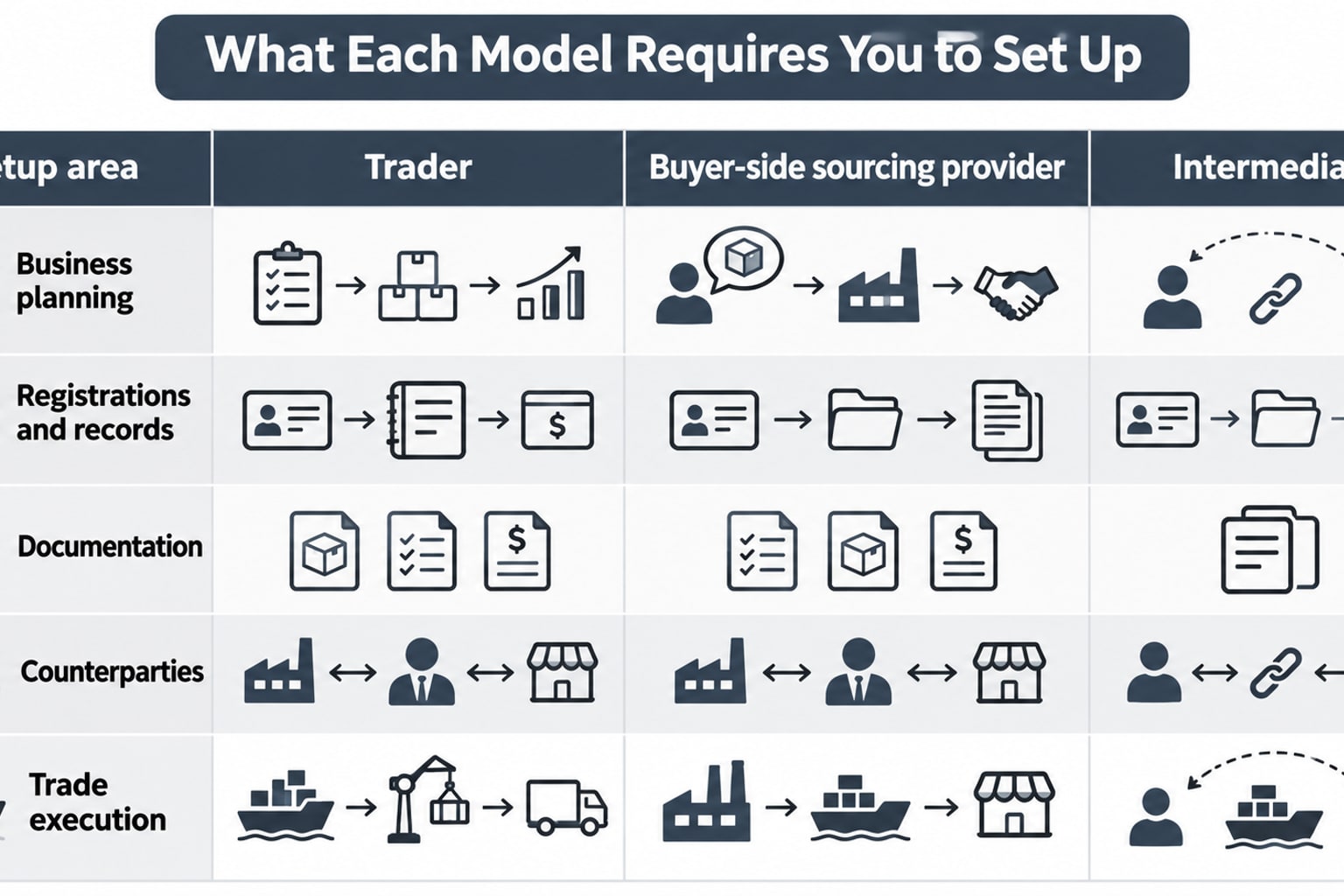
Each import-export role calls for a different setup: a trader plans and manages a goods transaction, a sourcing provider coordinates supply for a buyer, and an intermediary arranges connections between parties. In every case, plan the work, check applicable registrations and documentation, and decide who will coordinate suppliers, buyers and trade execution before taking on a deal.
The table compares the main setup responsibilities. Exact registrations and documents depend on your business structure, product, trade route and role, so verify requirements that apply to your planned transactions.
| Setup area | Trader | Buyer-side sourcing provider | Intermediary |
|---|---|---|---|
| Business planning | Plan the product, target market, pricing, costs and how you will buy and resell goods. | Define the buyer’s sourcing needs, supplier criteria, service scope and how you will charge for your work. | Specify which parties you will connect, the introduction or coordination work you will perform, and how your compensation will be agreed. |
| Registrations and records | Check the registrations and trade permissions relevant to your business, products and route. Keep purchase, sales and payment records. | Check registrations applicable to your business and service activities. Keep clear records of buyer requirements, supplier quotations and agreed work. | Check registrations relevant to your business activities. Record introductions, communications, agreed responsibilities and payment terms. |
| Documentation | Prepare to coordinate commercial documents and shipment information for the transaction; confirm who prepares and checks each item. | Organise product specifications, supplier offers and sourcing updates for the buyer. Clarify who handles orders, shipping documents and payment. | Document the parties’ roles and any agreed introduction or coordination terms. Confirm whether you are responsible for any trade paperwork. |
| Coordination and execution | Manage supplier orders and buyer commitments, then coordinate payment, logistics and delivery responsibilities. | Coordinate the buyer’s requirements with suppliers and clarify who approves samples, places orders and manages delivery. | Keep communication between parties clear, but do not assume responsibility for goods, payment or shipment unless agreed. |
Choose the Role You Can Support in Practice
Choose the role that fits the skills, business relationships and trade responsibilities you can manage consistently. Before committing to a model, consider what you can contribute directly, whether you can reach suitable suppliers or buyers, and how much coordination you are prepared to handle through a transaction.
Start with your capabilities. If you can assess product quality, negotiate purchasing terms and manage inventory or shipment coordination, buying and reselling may fit your operating capacity. If your strength is identifying suppliers, comparing their offers and keeping a buyer informed, a sourcing role may be more practical. If you have access to relevant contacts and can communicate clearly between parties, an intermediary role may suit you, provided you define your responsibilities and compensation before work begins.
Next, assess your access to counterparties. List the supplier relationships, buyer contacts, product knowledge and market information you can rely on now—not only those you hope to develop. Consider how you will verify a potential counterpart and respond if specifications, pricing, delivery expectations or payment terms need clarification. A model that depends on relationships you cannot yet reach may require more preparation before trading.
Finally, be realistic about the work you are willing to own. Consider the time and capacity available for documentation, communication, compliance checks and logistics coordination, as well as the financial exposure involved in your chosen role. GFE Business’s Exim Business Setup provides guidance for planning, registering and preparing the business around the role you select, which can help you identify setup requirements before proceeding.
Choose a Manageable Role Before You Begin Trading
The most workable import export business model is the one whose duties you can manage consistently, not simply the one that sounds easiest to start. Before you begin trading, consider what you can handle day to day, which business relationships you can build, and how much responsibility you are prepared to take for the transaction.
Make the decision against your current capabilities rather than assumptions about potential returns. For example, if you are prepared to coordinate suppliers, customers, documentation and shipment details, you may be able to support a role with direct responsibility for trade execution. If you have stronger access to buyers or suppliers than operational capacity, consider whether a role with a narrower set of duties is more realistic. In either case, identify which tasks you would manage yourself and which require professional support before committing to a transaction.
Write down the responsibilities your chosen role involves, then check whether you have the time, contacts and working knowledge to carry them out. Note gaps that need to be addressed, such as understanding applicable registrations, preparing trade documents or coordinating counterparties. This gives you a practical basis for deciding what to arrange before accepting an order or making a commitment.
Choose the role whose trade responsibilities you can support in practice, and prepare for those duties before you begin trading. If you want guidance planning, registering and preparing your business for import-export trade, review GFE Business Exim Business Setup as a next step.