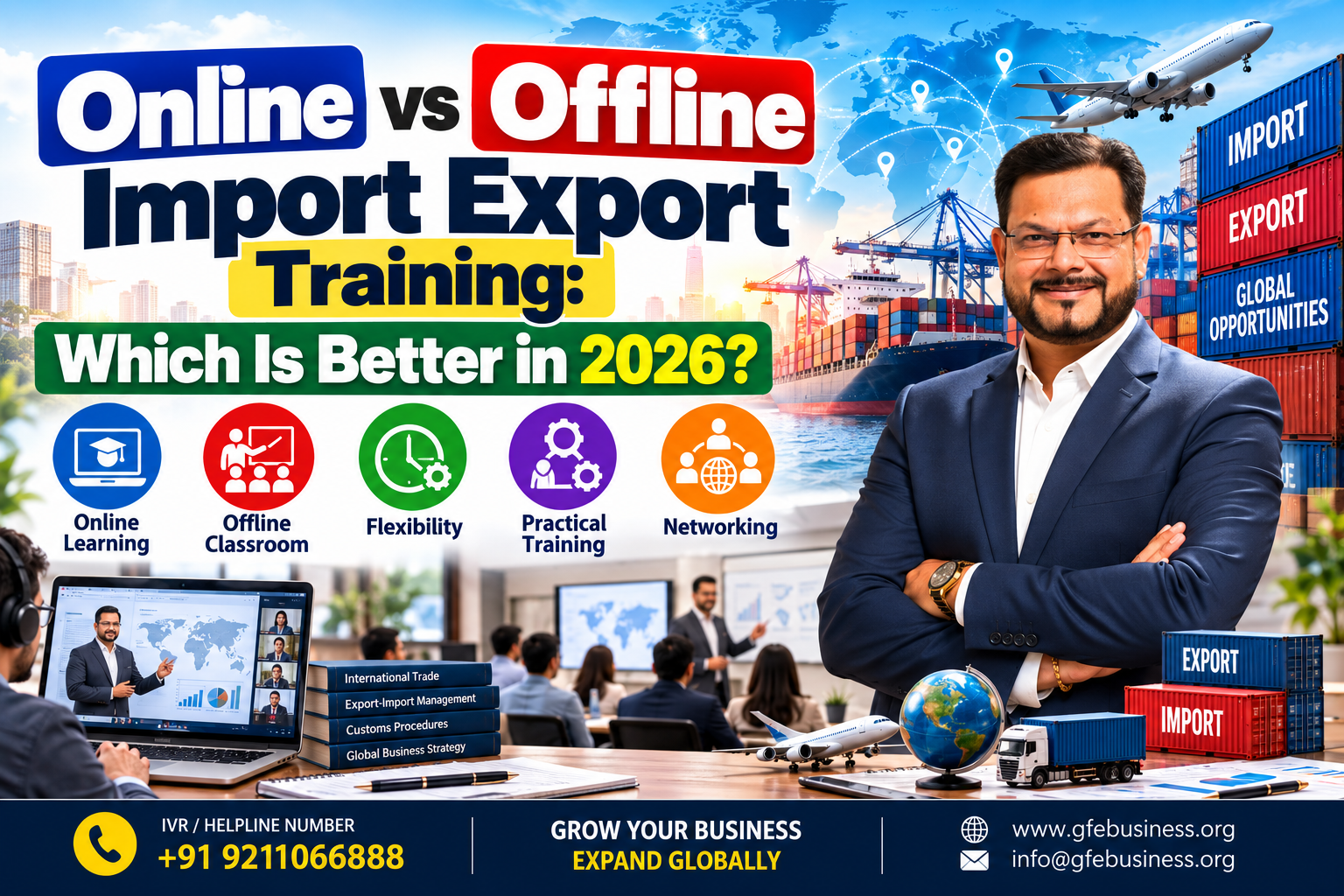
Online vs Offline Import Export Training: Which Is Better in 2026?
Neither online nor offline import export training is automatically better for everyone. Online training is usually more convenient for working professionals, business owners and learners outside major cities, while offline classes can be more suitable for people who learn better through face-to-face interaction, classroom discussion and local networking. The better choice in 2026 is the course that combines a practical curriculum, trainer access, current EXIM procedures and hands-on learning.
If you are searching for an online vs offline import export course, you are probably trying to answer one practical question: should you learn EXIM from home or attend physical classes?
The answer depends less on the format and more on how the training is delivered. A course that only explains theory may not prepare you for an actual export or import transaction. A useful program should help you understand IEC and DGFT procedures, trade documentation, product and market research, buyer or supplier finding, costing, customs, logistics and international payments.
India's international trade ecosystem is also continuing to expand. The Ministry of Commerce estimated India's combined merchandise and services exports at US$860.09 billion in FY2025–26, compared with US$825.26 billion in FY2024–25. That makes practical knowledge of international trade increasingly relevant for entrepreneurs, MSMEs and professionals.
Online vs Offline Import Export Course: Which One Is Better?
The better option depends on your learning style, location, schedule and business objective. Online training offers flexibility and easier access, while offline training can provide more direct classroom interaction and face-to-face networking.
| Factor | Online Training | Offline Training |
|---|---|---|
| Location | Can learn from home or office | Requires classroom attendance |
| Flexibility | Usually more flexible | Fixed or scheduled classes |
| Trainer Interaction | Depends on live sessions and support | Direct classroom interaction |
| Networking | Online community and discussions | Face-to-face networking |
| Travel | No regular travel required | Travel to training location |
| Best For | Professionals, business owners and remote learners | Classroom-focused learners |
What Is Online Import Export Training?
Online import export training allows learners to study EXIM concepts and practical processes without attending a physical classroom.
Depending on the provider, online courses may include live instructor-led sessions, recorded lessons, digital study material, assignments, case studies and question-and-answer sessions.
Online learning can be particularly useful if you live outside the training centre's city or already have a full-time job or business.
Advantages of Online EXIM Training
- Learn from your home or office.
- Reduced travel and accommodation costs.
- More convenient for working professionals.
- Useful for learners living outside major business cities.
- Can fit around an existing business schedule.
- Digital material can make revision easier.
- Access to online discussions and support where provided.
Disadvantages of Online Import Export Training
- Requires self-discipline.
- Internet or technical problems can interrupt classes.
- Networking may be less personal.
- Some learners find it harder to remain focused at home.
- Recorded-only courses may provide limited trainer interaction.
What Is Offline Import Export Training?
Offline import export training takes place in a physical classroom where learners and trainers interact directly.
Classroom training can be useful for students and entrepreneurs who prefer face-to-face explanations, immediate questions and discussions with other learners.
Advantages of Offline EXIM Training
- Direct interaction with trainers.
- Immediate discussion of questions.
- Face-to-face networking with other participants.
- Can provide a structured learning routine.
- Useful for learners who prefer classroom environments.
- Practical demonstrations can be easier for some learners to follow.
Disadvantages of Offline Training
- Requires travel to the training centre.
- Classes may follow a fixed timetable.
- Travel can increase the overall time commitment.
- May not be convenient for learners living far from the institute.
- Classroom size and trainer availability can affect the learning experience.
Which Is Better for Beginners?
For beginners, the quality and practical depth of the course matter more than whether it is online or offline.
A beginner should be able to understand the complete trade process rather than memorise definitions.
Before enrolling, check whether the course explains:
- Import-export fundamentals
- IEC and DGFT procedures
- HS codes and product classification
- Export-import documentation
- Product and international market research
- Finding international buyers
- Finding international suppliers
- Export costing and pricing
- Incoterms
- Customs and logistics
- International payment methods
- GST and trade compliance basics
DGFT guidance explains that an Importer Exporter Code is a key requirement for most import and export activities, subject to applicable exemptions. The application process is handled online through the DGFT system.
Online vs Offline Training for Working Professionals
Online training is usually more convenient for working professionals because it can reduce travel and fit around existing work commitments.
For example, someone working from 10 AM to 7 PM may find scheduled online evening sessions easier to manage than travelling to a training centre after work.
However, an offline course may be better if the learner needs a fixed classroom routine to remain consistent.
Online vs Offline Training for Business Owners
Business owners should choose the format that allows them to apply the learning directly to their business.
If you already operate a business, online training can make it easier to study while continuing daily operations. You can also discuss your own product, market or sourcing questions during live sessions if the provider offers trainer interaction.
Offline training can be valuable when you want face-to-face discussions and local networking with other entrepreneurs.
If you are starting from zero, you can also read our guide on how to start an import-export business without experience.
Which Format Is Better for Practical Import Export Training?
Practical training is possible in both formats, but you should check what “practical” actually means before enrolling.
A practical EXIM course should go beyond PowerPoint presentations and explain how real trade activities work.
For example, learners should ideally work through practical exercises involving:
- Product selection.
- Target-market research.
- HS code identification.
- IEC and DGFT procedures.
- Buyer or supplier research.
- Quotation preparation.
- Export costing.
- Commercial invoice and packing list.
- Shipping and logistics workflow.
- International payment process.
GFE Business currently describes its training as practical and says its curriculum includes market research, IEC/DGFT processes, buyer and supplier finding, customs clearance, shipping, documentation, GST and logistics.
Online vs Offline Import Export Course Fees
Course fees vary widely, so learners should compare what is included rather than choosing a course only because it is cheaper.
The total cost can depend on:
- Course duration
- Live or recorded classes
- Trainer access
- Study material
- Assignments and practical exercises
- Certification
- Business setup guidance
- Post-training support
- Additional services
| Cost Factor | Online | Offline |
|---|---|---|
| Course Fee | Depends on provider | Depends on provider |
| Travel | Usually not required | May add cost |
| Accommodation | Usually not required | May be required for outstation learners |
| Study Material | Often digital | May be physical or digital |
Never assume that online automatically means cheap or offline automatically means expensive. Compare the complete package.
Which Is Better for Students?
Students should choose based on their learning style and the amount of practical interaction they need.
Offline classes can provide a more structured routine and face-to-face communication. Online courses can provide flexibility, especially for students balancing college, internships or other commitments.
If the course includes live sessions, assignments, trainer interaction and practical case studies, online learning can also be a strong option for students.
Which Is Better for Learning IEC, Documentation and DGFT?
Both formats can teach IEC, DGFT and documentation effectively if the training is practical and up to date.
These subjects do not require a physical classroom by themselves. What matters is whether the trainer demonstrates the actual workflow and gives learners an opportunity to understand documents and procedures.
For example, a good lesson should not simply define a Commercial Invoice. It should explain what information is included, how it relates to the shipment and how it differs from documents such as a Packing List or Shipping Bill.
DGFT's official guidance provides information on IEC and import-export procedures, making official government resources an important reference alongside training.
What About International Payments and Banking?
International payment and foreign-exchange procedures are important parts of EXIM training and should not be skipped.
Exporters and importers need to understand payment terms, documentation, banking processes and applicable foreign-exchange requirements.
The Reserve Bank of India publishes directions covering export and import transactions under the FEMA framework. Learners should use current RBI directions and their authorised dealer bank for transaction-specific requirements.
Online vs Offline Import Export Training in Ahmedabad
For Ahmedabad learners, both options can work; the choice depends on whether you value classroom interaction or location flexibility.
Ahmedabad has a strong business ecosystem across textiles, manufacturing, pharmaceuticals, food and other sectors. GFE Business currently offers import-export training in Ahmedabad and describes both regular and distance learning options, along with practical training.
If you live in Ahmedabad and prefer classroom interaction, an offline program may be convenient. If you live in Surat, Rajkot, Vadodara, Mumbai, Delhi or another city, online training may eliminate the need to travel regularly to Ahmedabad.
You can also explore the Import Export Course in Ahmedabad if you specifically want location-based training information.
How to Choose the Right Import Export Course in 2026
Use the curriculum and practical support as your primary selection criteria, not just the delivery format.
- Check the syllabus: Make sure the course covers the complete EXIM transaction.
- Check trainer access: Find out whether you can ask questions during or after sessions.
- Check practical exercises: Ask whether you will work with actual trade documents and case studies.
- Check current content: International trade regulations and procedures can change.
- Check certification: Understand exactly what certificate is provided.
- Check support: Ask whether post-training assistance is available.
- Compare total cost: Include travel and accommodation if choosing offline classes.
- Check reviews carefully: Look for specific feedback about training quality rather than relying only on star ratings.
GFE Business Export Import Training: Online and Practical Learning
GFE Business positions its EXIM training around practical international trade learning, with flexible learning options and a curriculum covering the major stages of import-export operations.
Its current training information highlights market research, IEC and DGFT procedures, international buyer and supplier finding, customs clearance, shipping, documentation, GST and logistics. The Ahmedabad page also describes regular and distance learning options.
GFE Business's current website states that its community includes 25,000+ business owners across 35+ countries and 100+ cities. These are GFE's own published figures and should be understood as company-reported information.
Explore GFE Business Export Import Training
Online vs Offline: Which One Should You Choose?
Choose online training if flexibility, location independence and convenience are your top priorities. Choose offline training if face-to-face interaction, classroom structure and local networking are more important to you.
| If You Are... | Consider |
|---|---|
| Working professional | Online |
| Business owner with limited time | Online |
| Learner living far from an institute | Online |
| Student who prefers classroom learning | Offline |
| Entrepreneur seeking local networking | Offline may be useful |
| Self-directed learner | Online can work well |
📚 Related Reads
- Import Export Course Training in India
- Import Export Business Training in Ahmedabad
- How Beginners Can Find International Buyers
- How to Start Import Export Without Experience
Online vs Offline Import Export Training FAQ
Q: Is online or offline import export training better in 2026?
A: At GFE Business, we believe the better option depends on your learning style, schedule and business goals. Online import-export training offers flexibility and is convenient for working professionals and learners from different cities, while offline training provides face-to-face classroom interaction. GFE Business provides practical Export Import Training designed to help learners understand the complete EXIM process.
Q: Does GFE Business provide online import export training?
A: Yes. GFE Business provides flexible import-export training options for learners who want to understand international trade without being limited by location. The training covers important areas such as IEC and DGFT procedures, export-import documentation, market research, buyer and supplier finding, customs, logistics and international trade processes.
Q: Does GFE Business offer offline import export training?
A: Yes. GFE Business offers import-export training in Ahmedabad for learners who prefer classroom-based learning and direct interaction. Offline training can be useful for entrepreneurs and beginners who prefer face-to-face discussions, practical explanations and classroom interaction.
Q: Which is better for beginners: online or offline import export training?
A: For beginners, the quality and practical content of the training matter more than whether the course is online or offline. At GFE Business, learners can study important EXIM topics including IEC, DGFT, documentation, product research, international buyers and suppliers, export costing, customs and logistics. Choose the learning format that matches your schedule and preferred learning style.
Q: Is GFE Business good for learning import export business?
A: GFE Business focuses on practical import-export and EXIM business training rather than only theoretical concepts. The training covers key areas involved in starting and understanding an international trade business, including documentation, IEC/DGFT procedures, buyer and supplier research, logistics, customs and export-import processes.
Q: What is included in GFE Business Import Export Training?
A: GFE Business training covers major areas of international trade, including import-export business fundamentals, IEC and DGFT procedures, product and market research, international buyer and supplier finding, export-import documentation, customs clearance, shipping, logistics, GST and other practical EXIM processes. The exact curriculum and available support can depend on the selected training program.
Q: Can I learn import export business online with GFE Business?
A: Yes. GFE Business offers flexible learning options for people who want to learn import-export business online. This can be particularly useful for working professionals, entrepreneurs and learners who cannot regularly attend classroom sessions. You can learn important EXIM concepts while continuing your existing work or business activities.
Q: Is GFE Business import export training suitable for working professionals?
A: Yes. GFE Business import-export training can be suitable for working professionals because flexible learning options can reduce the need for regular travel to a classroom. Professionals can learn about international trade, export documentation, buyers, suppliers, logistics and other EXIM processes alongside their existing work.
Q: Which import export course is best for beginners in India?
A: The best import-export course depends on your learning objective, budget and preferred learning format. GFE Business is an option for beginners looking for practical Export Import Training in India, with training focused on important areas such as IEC/DGFT, documentation, market research, buyers, suppliers, customs and logistics.
Q: Can GFE Business help me understand how to start an export business?
A: Yes. GFE Business provides import-export business training and guidance that can help beginners understand the major steps involved in starting an export business, including product selection, market research, applicable registrations, documentation, finding international buyers, costing and logistics. Training can provide knowledge and guidance, but business success depends on market demand, execution, compliance and other factors.
Q: Does GFE Business provide import export training in Ahmedabad?
A: Yes. GFE Business provides Import Export Training in Ahmedabad, including training options for learners who prefer classroom-based or flexible learning. The Ahmedabad training covers important EXIM business topics and is designed for entrepreneurs, beginners and professionals interested in international trade.
Q: Can I learn import export without any previous experience?
A: Yes. GFE Business's import-export training can be suitable for beginners without previous EXIM experience. The learning process starts with international trade fundamentals and can progress into practical areas such as IEC/DGFT procedures, documentation, product research, buyer and supplier finding, costing, customs and logistics.
Q: Does GFE Business provide a certificate after import export training?
A: Certificate availability depends on the specific GFE Business training program you choose. Before enrolling, learners should confirm the current course structure, certification details, duration and inclusions directly with GFE Business.
Q: How do I choose between online and offline training at GFE Business?
A: Choose online import-export training if flexibility and location convenience are your priorities. Choose offline training in Ahmedabad if you prefer classroom interaction and face-to-face learning. If you are unsure, compare the current GFE Business course structure, schedule, curriculum and support options before enrolling.
Q: How can I join GFE Business Import Export Training?
A: You can explore the current GFE Business Export Import Training program to understand the available training options, curriculum and support. Choose the program that matches your business objective and preferred learning format
Conclusion: Online or Offline Import Export Training?
The online vs offline decision should not be reduced to a simple question of which format is “best.” The more important question is whether the training can give you the knowledge and practical skills required to understand an international trade transaction.
If you need flexibility, live online training can be a strong choice. If you learn better through face-to-face interaction and classroom structure, offline training may suit you better.
Whichever format you choose, look for a course covering IEC, DGFT, documentation, HS codes, market research, buyers and suppliers, costing, customs, logistics and international payments.
If you're ready to develop practical EXIM knowledge in 2026, explore GFE Business's current export-import training program and compare the available learning options with your own goals.
Explore GFE Business Export Import Training →
About GFE Business / Reviewed by Trade Experts
GFE Business is part of GFE Group and provides import-export training, EXIM business guidance, documentation support, business setup assistance and international trade-related services. Its current website presents practical training covering market research, IEC/DGFT procedures, documentation, customs, logistics and buyer-supplier communication.
online vs offline import export course, online import export course 2026, offline import export course 2026, import export training 2026, export import training India, online EXIM training, offline EXIM training, import export course for beginners, best import export course India, practical import export training, import export course Ahmedabad, import export classes near me, import export training fees, import export course duration, online export import course India, import export certification course, EXIM course for entrepreneurs, export import training for working professionals, import export course online India