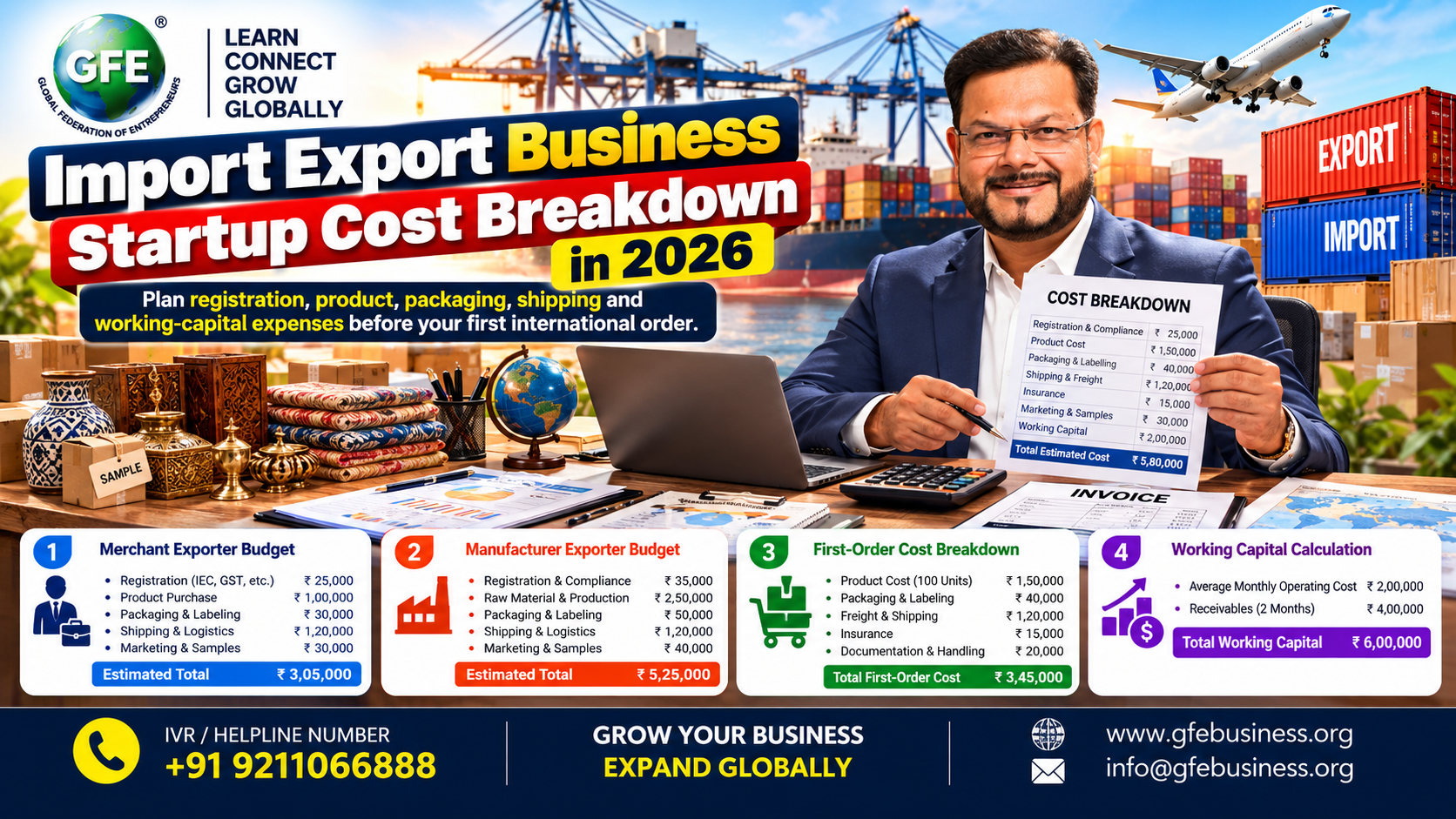
The cost to start an import export business in India depends on your business model, product, target country, order size and payment terms. A merchant exporter who sources products after receiving an order has a different budget from a manufacturer who buys machinery, rents a workspace and maintains inventory.
There is no single startup amount that applies to every EXIM business. Your budget should cover three separate areas: business setup and registration, operating and shipment expenses, and working capital to pay suppliers and other costs before the buyer's payment arrives.
This 2026 guide explains the main expenses, shows how to prepare a practical budget, and highlights where beginners can avoid spending money before it is necessary.
Quick Answer: How Much Does It Cost to Start an Import Export Business?
The required capital varies considerably. A low-overhead merchant exporter may begin by researching buyers and suppliers before committing to stock, while an inventory-based importer or manufacturer may need substantially more capital.
As an initial planning exercise, you can build a budget for a small pilot order, a regular merchant-export operation or a manufacturing-based business. The figures below are illustrative planning scenarios, not official minimum investment requirements or promises of business success.
| Business model | What drives the budget | Best budgeting approach |
|---|---|---|
| Low-overhead merchant exporter | Samples, supplier coordination, basic business costs, packaging and small shipments | Start with a limited product range and a costed pilot order |
| Merchant exporter with inventory | Product purchase, storage, packaging, freight and the gap between supplier payment and buyer payment | Calculate the full cost of the first order plus a cash-flow reserve |
| Importer holding stock | Supplier advance, international freight, insurance, applicable duties and taxes, clearance and domestic delivery | Estimate landed cost before placing the purchase order |
| Manufacturer-exporter | Equipment, workspace, production inputs, labour, testing, packaging and operating capital | Prepare a separate setup budget and working-capital forecast |
For context, an industry article published in October 2026 describes registration as only one part of export startup costs and highlights samples, stock, freight and working capital as major variable expenses. Your own budget should be based on quotations and the requirements of your chosen product and market.
1. Business Registration and Administrative Costs
Before committing to a large order, identify which legal structure suits your business. A proprietorship, partnership, LLP and private limited company have different establishment, compliance and administration requirements.
| Expense | What to check |
|---|---|
| Business structure and registration | Applicable government charges, professional fees, documentation and recurring compliance costs |
| PAN and identity records | Whether you need a separate entity PAN or additional records for your chosen structure |
| Banking | Account opening conditions, minimum balance, transaction charges and foreign-exchange services |
| Importer-Exporter Code (IEC) | Current application fee, eligibility and applicable exceptions |
| Tax-related setup | Whether registration and other compliance requirements apply to your business and transactions |
| Professional assistance | Fees for a chartered accountant, company secretary, lawyer or trade professional, if needed |
A secondary industry source published in October 2026 reports an IEC application fee of ₹500. Treat this as a reference for planning, not a substitute for checking the current fee and application requirements before filing.
Do not assume that every business needs to incorporate a private limited company or pay for every available registration. Choose a suitable structure and confirm the registrations relevant to your activity.
2. Product Research, Samples and Quality Checks
Product-related expenses can begin before you receive your first order. You may need to identify suppliers, request samples, inspect quality, compare specifications or arrange product testing.
Potential costs include:
- Product and market research.
- Supplier sample charges.
- Courier or sample-shipping charges.
- Inspection or testing, where needed.
- Translation, labelling or specification preparation.
- Time spent comparing supplier quotations and negotiating terms.
These costs depend on the product. A lightweight sample may be relatively inexpensive to send, while specialised, fragile, regulated or bulky goods can require more preparation and testing.
3. Product Procurement and Inventory
Product procurement is often one of the largest expenses in an import-export business. The amount depends on the minimum order quantity, supplier terms, product value and whether you purchase inventory before finding a buyer.
Merchant exporter
A merchant exporter sources goods from manufacturers or suppliers and sells them to international buyers. Depending on the agreement, the exporter may buy products only after receiving a confirmed order or may maintain stock to meet demand faster.
Manufacturer-exporter
A manufacturer-exporter may need raw materials, machinery, production space, labour, quality-control processes and finished-goods inventory. These expenses make its startup budget fundamentally different from that of a low-overhead merchant exporter.
Importer
An importer buying overseas stock for resale should budget for the supplier's price and the costs of bringing the goods into India. Depending on the product and transaction, this may include freight, insurance, customs duty, applicable taxes, clearance, handling and domestic transport.
4. Packaging, Labelling and Product Compliance
Packaging is not simply a presentation expense. It can affect product safety, freight charges, buyer acceptance and compliance with the destination market's rules.
Include relevant expenses for:
- Export-suitable cartons, pallets or protective materials.
- Product labels and buyer-specific packaging requirements.
- Marking, barcodes or identification information where required.
- Testing, inspection, fumigation or product certificates when applicable.
- Special handling for food, fragile, temperature-sensitive or regulated goods.
Do not budget for every certificate by default. Confirm which requirements apply to your product, buyer, destination and shipment before placing an order.
5. International Freight, Insurance and Customs Clearance
International shipping costs depend on the origin, destination, shipment weight and dimensions, transport mode, cargo characteristics and agreed delivery terms. Air freight may suit urgent or lightweight shipments, while sea freight is often considered for larger consignments.
Ask logistics providers for a written quotation covering the services you actually need. Depending on the transaction, the budget may include:
- Domestic transport to the departure point.
- International freight.
- Customs broker or clearance services.
- Terminal, handling or documentation charges.
- Cargo insurance, where arranged or appropriate.
- Destination-side charges or domestic delivery, where these are your responsibility.
Do not compare freight quotations without checking what each quote includes. The agreed Incoterm and contract determine which party is responsible for particular costs and risks.
For export costing, the Government of India's IndBiz guide recommends considering expenses from sampling through the realisation of export proceeds, based on the agreed sale terms. Read the export process and costing guidance for further context.
6. Website, Communication and Buyer Development
New exporters may need a professional email address, product catalogue, clear product photographs, a business profile or a simple website. The appropriate budget depends on the sales strategy and how much work can be completed in-house.
Potential expenses include:
- Domain and website hosting.
- Product photography and catalogue preparation.
- Business email and communication tools.
- Buyer research and lead-generation services.
- Trade fair participation or business travel, if planned.
- Translation or market-specific sales materials.
These are business-development choices rather than universal government registration fees. Prioritise activities that help validate genuine demand and reach relevant buyers.
7. Working Capital: The Cost Many Beginners Underestimate
Working capital is the money needed to pay business expenses while waiting for money from customers. Even a business with limited registration costs may face a significant funding requirement if it must pay a supplier before receiving payment from its buyer.
For each order, estimate:
- Supplier advance and remaining product payment.
- Packaging, testing and handling expenses.
- Transport, freight and insurance.
- Applicable taxes, duties and clearance charges.
- Bank and foreign-exchange charges.
- Any remaining operating expenses due before customer payment.
Then subtract only the funds that will genuinely be available by the relevant payment dates. A signed order does not automatically mean that the customer has already funded your costs.
8. How to Calculate Your First-Order Budget
Use this simple framework to estimate the money needed before committing to a shipment.
| Budget component | How to calculate it |
|---|---|
| One-time setup | Applicable business formation, registration, banking and professional costs |
| Product and samples | Supplier quotations, sample orders and any required inspection or testing |
| Order preparation | Packaging, labelling, documentation and handling |
| Logistics | Quoted transport, freight, insurance, clearance and delivery charges |
| Working-capital reserve | Expenses due before customer funds become available, plus a reasonable contingency |
Illustrative calculation: Suppose a pilot order involves ₹60,000 in product purchases, ₹8,000 for packaging and testing, ₹15,000 for transport and logistics, and ₹7,000 in other order-related costs. The order-related outlay would be ₹90,000, before any additional setup costs and contingency. These amounts are examples only, not current market quotations.
If the buyer pays an advance, your immediate funding requirement may be lower. If you must pay the supplier and logistics providers before receiving customer payment, you may need to finance most or all of the outlay yourself.
9. Common Budgeting Mistakes to Avoid
- Budgeting only for registrations: Registration is just one part of the total business cost.
- Ignoring the product's minimum order quantity: A low unit price may still require a large initial purchase.
- Using an unverified freight estimate: Obtain a quotation based on the actual cargo and route.
- Forgetting destination-side costs: Confirm which party pays each charge under the agreed contract.
- Ignoring payment timing: Estimate when suppliers must be paid and when customer funds are expected.
- Paying for unnecessary services: Confirm the value and relevance of each service before committing.
- Assuming every product follows the same rules: Product-specific licences, testing or certificates may affect the budget.
- Treating an estimate as a guarantee: Costs change with product prices, routes, exchange rates, order size and service-provider quotations.
10. How GFE Business Can Help You Prepare
Starting an import-export business involves more than calculating a budget. Entrepreneurs also need to understand product selection, market research, documentation, international pricing, logistics, payment methods and buyer communication.
GFE Business describes import-export training, documentation guidance and business setup support on its website. If you are still evaluating your options, review the GFE Business import-export training and setup page to learn about its stated offerings.
You can also compare this article with GFE Business's existing minimum investment guide. The existing page should be reviewed for updates and overlap before this new article is published.
Training and general business guidance do not replace advice from qualified legal, tax, banking or logistics professionals. Before investing, confirm the costs and requirements relevant to your chosen product, business structure and target market.
Frequently Asked Questions
1. What is the cost to start an import export business in India?
There is no single cost for every business. Your budget depends on registrations, product procurement, samples, packaging, freight, compliance and working capital. Calculate these separately for your intended business model.
2. Can I start an export business with a small budget?
A low-overhead model may reduce initial expenses, especially when you validate demand before purchasing inventory. However, even a small shipment can involve samples, packaging, transport and documentation costs. Obtain quotations before committing.
3. Is the IEC application fee the total cost of starting an export business?
No. An IEC application fee is only one potential setup expense. Product procurement, packaging, logistics, professional services and working capital can represent much larger costs, depending on the transaction.
4. Is a physical office compulsory for every import-export business?
Not necessarily. The need for premises depends on the business model and applicable verification or product requirements. Confirm acceptable business-address evidence and any location-specific obligations before relying on a home-based setup.
5. Which costs should an importer calculate before ordering goods?
An importer should estimate supplier payments, freight, insurance, applicable customs duties and taxes, clearance, handling, domestic delivery and working capital. The exact landed cost depends on the product, origin, transaction terms and applicable rules.
6. Do merchant exporters and manufacturers need the same investment?
No. A merchant exporter may source products from other businesses, while a manufacturer may also need equipment, production space, labour, raw materials and quality-control facilities. Their budgets can differ substantially.
7. How much working capital should a new exporter keep?
Estimate the expenses due before customer payment becomes available and add a contingency appropriate to your business. The required amount depends on order size, supplier terms, buyer payment terms and the time needed to receive funds.
8. Can GFE Business help beginners understand import-export business setup?
GFE Business describes import-export training and business setup support on its website. Interested readers can review the relevant service information and contact the GFE Business team to ask about suitable options.
Conclusion
The cost to start an import export business in India depends on the business structure, product, shipment size, logistics arrangements and payment terms. Do not base your budget only on registration charges. Calculate the cost of preparing and delivering the first order, then account for the period before customer payment arrives.
Start with a clearly defined business model, verify genuine buyer demand, obtain supplier and logistics quotations, and confirm the requirements that apply to your product. If you need help understanding the wider EXIM process, explore the relevant options from GFE Business or contact the team to discuss your learning and business setup needs.