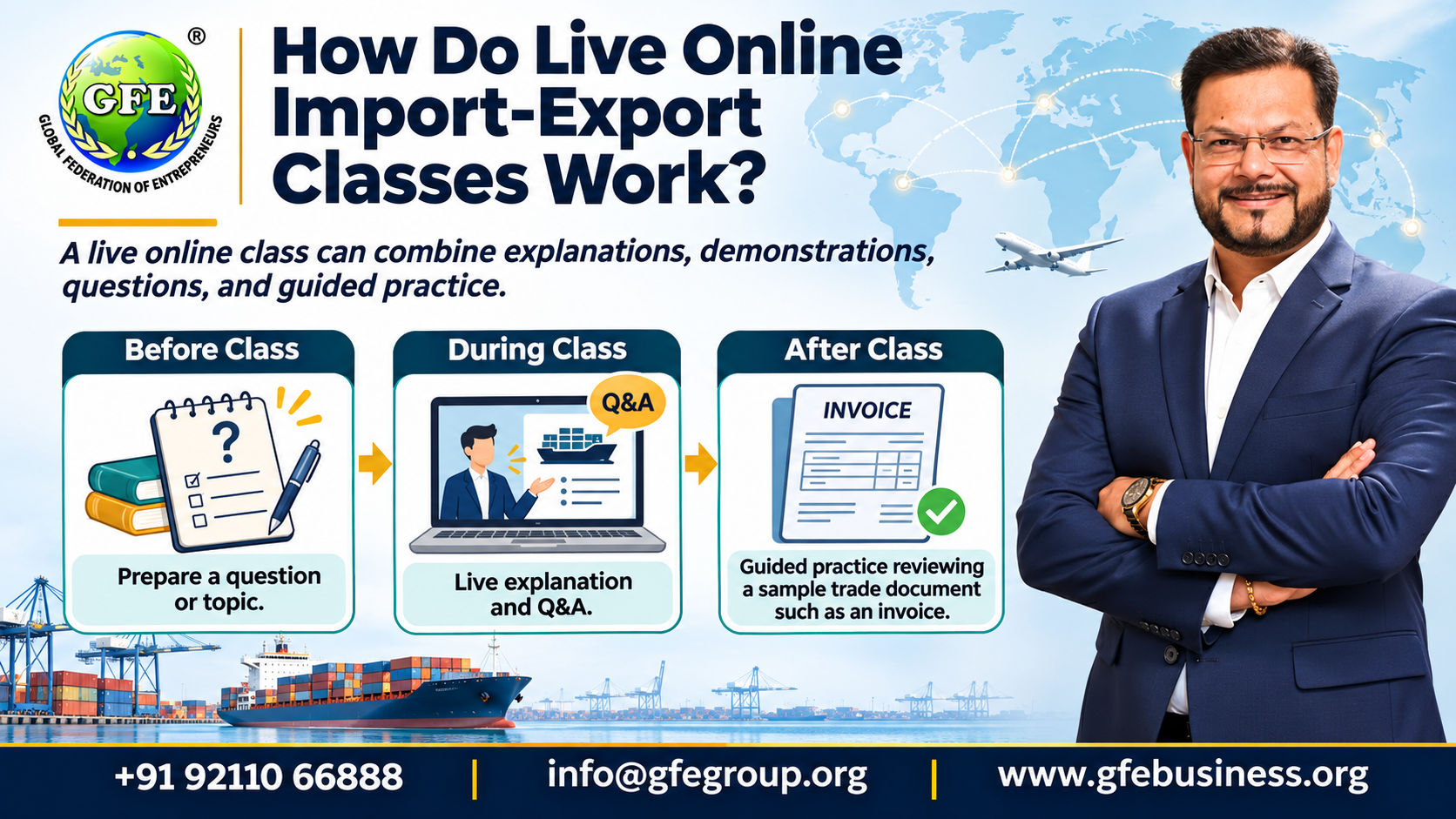
How Do Live Online Import-Export Classes Work?
Live online import-export classes are trainer-led sessions that learners attend remotely at a scheduled time. A class may include an explanation of a trade topic, a screen-shared demonstration, time for questions, and a guided exercise. The exact format depends on the course provider, so check whether the programme is genuinely interactive and what practical work is included.
For someone exploring international trade, an online class can make it possible to learn without travelling to a classroom. The useful question is not only “Are classes live?” but also “What will I do during the session, how can I ask questions, and what support is available afterwards?”
What happens in a live online import-export class?
A live class usually follows a planned lesson rather than asking learners to study everything alone. A trainer introduces the topic, explains how it fits into the trade process, and may demonstrate a task or review an example. Learners can then ask questions or try a related exercise, depending on the course design.
For example, a session about buyer research might explain how to define a suitable buyer profile, demonstrate a research process, and invite learners to assess a sample lead. A session about documentation might use sample information to explain what common fields mean. These are examples of activities to ask about; they are not a claim that every provider includes them.
How the online class journey usually works
| Stage | What may happen | What to confirm |
|---|---|---|
| Before class | You receive the session time, joining instructions, and possibly a topic or preparation task. | How links and schedule updates are shared, and whether materials are provided. |
| During class | The trainer explains a topic, may demonstrate a process, and may take learner questions. | Whether learners can ask questions live and how much time is set aside for interaction. |
| Practice | You may review a sample document, discuss a case, or complete a guided task. | Which exercises are included and whether anyone reviews your work. |
| After class | You may revise the topic, finish an assignment, or raise questions through the provider’s stated support channel. | What follow-up is available, for how long, and whether any extra charges apply. |
What you may learn through live online EXIM training
Course topics vary. GFE Business’s published training information includes areas such as the import-export cycle, product and market selection, buyer finding, trade documentation, business setup, and shipping and logistics. Check the GFE Business Export Import Training page and confirm which topics and practical activities are part of the current programme.
Depending on the course, a live class may help you:
- Understand how a trade enquiry can progress toward delivery and payment.
- Practise researching a product or target market using a sample scenario.
- Discuss how to assess whether a potential buyer fits your product and market.
- Review the purpose of common trade documents using sample information.
- Identify cost items and questions to consider before preparing a quotation.
- Understand how trade terms, payment, shipping, and logistics connect.
Learning exercises are for education. A sample document or classroom explanation should not be treated as instructions for every real transaction. Product, destination, and transaction details can change what needs to be checked.
What do you need to attend online classes?
Most remote classes require a stable internet connection and a device that can access the class platform. A headset can make it easier to hear and speak, while a notebook or digital document can help you keep track of unfamiliar terms and questions. Ask the provider which platform it uses and whether the class can be joined by phone as well as computer.
You do not need to be an experienced trader to benefit from introductory learning. If you are new, tell the provider your background and ask whether the course begins with trade fundamentals. GFE Business has a separate course eligibility guide for readers checking who may join.
How to participate effectively in a live class
- Join a little early. Check your audio, connection, and access to any material before the lesson begins.
- Keep the topic in view. Note unfamiliar terms and write down questions as they arise.
- Use examples from your goal. If you are considering a product or career path, ask how the lesson applies to that situation.
- Attempt exercises yourself. Trying a task first helps you see exactly where you need clarification.
- Review after class. Summarise the main points and confirm any transaction-specific details before acting on them.
Live online classes compared with recorded lessons
Live and recorded learning serve different needs. A live class gives learners a scheduled opportunity to interact, if the course makes time for questions. A recorded lesson can be easier to revisit or fit around a changing schedule. Some programmes combine both, but the format and inclusions should be confirmed before enrolment.
| Learning format | Possible benefit | Question to ask |
|---|---|---|
| Live online class | Scheduled instruction and potential real-time questions. | How interactive are sessions, and are they recorded? |
| Recorded lesson | More flexibility to pause and revisit content. | How can learners get help when something is unclear? |
| Blended course | May combine scheduled classes with materials for independent review. | Which parts are live, and what support accompanies each format? |
If your main concern is choosing a learning format, see GFE Business’s guide to online versus offline import-export training. For subject coverage, review the separate import-export course syllabus guide.
Questions to ask before enrolling
- Are sessions live, recorded, or a mix of both?
- How often are live classes held, and what is the current schedule?
- Can learners ask questions during the class?
- Are practical exercises included, and does a trainer review them?
- What materials or recordings are available after each session?
- What support is available between sessions or after the course?
- What are the current fees, duration, certificate details, and course inclusions?
These details vary by provider and programme. Ask for the current terms in writing so you can compare the course with your goals and schedule.
How GFE Business can fit into your learning plans
GFE Business’s website describes export-import training and practical learning topics. Its online course information also discusses online learning and trainer interaction. However, public pages do not provide one complete, current schedule for every live online batch. Confirm the class timing, delivery platform, curriculum, exercises, and support arrangements directly with the team before enrolling.
To compare the learning format with classroom training, read GFE Business’s online-versus-offline guide. When you are ready to ask about a current programme, use the GFE Business contact page.
Frequently asked questions
How do live online import-export classes work?
They are scheduled remote sessions where a trainer explains a topic and may demonstrate a process, answer questions, or guide an exercise. The mix of teaching and practice depends on the course, so confirm the format before joining.
Do I need prior experience to join an online export-import class?
Not always. Some courses are designed for beginners, while others may expect prior knowledge. Check the specific programme’s entry requirements and ask whether lessons begin with the fundamentals.
Can I ask questions during a live online class?
That depends on how the provider runs its sessions. Ask whether questions are taken during class, at the end, or through a separate support channel, and whether a trainer responds between sessions.
Are live online classes better than recorded lessons?
Neither format is automatically better for everyone. Live classes can offer scheduled interaction, while recordings can be convenient to revisit. Consider your timetable, preferred learning style, and how the course handles questions and practice.
What should I check before joining live online import-export classes?
Confirm the schedule, platform, topics, live interaction, practical activities, recordings, support terms, fees, and certificate details. Ask for the current inclusions rather than relying on a general description of the course.
Does an online import-export course guarantee buyers or business success?
No. Training can help build knowledge and practise relevant tasks, but it cannot guarantee buyers, orders, profits, or business success. Outcomes depend on factors such as market demand, product fit, pricing, finance, compliance, and execution.
Explore the next step
If live online learning suits your schedule, compare the course content and support with the skills you want to develop. Review GFE Business’s export-import training information, then contact the team to confirm the current online batch format and details before deciding.